The ultimate guide to hotel direct bookings in 2026: strategy, tools, and conversion
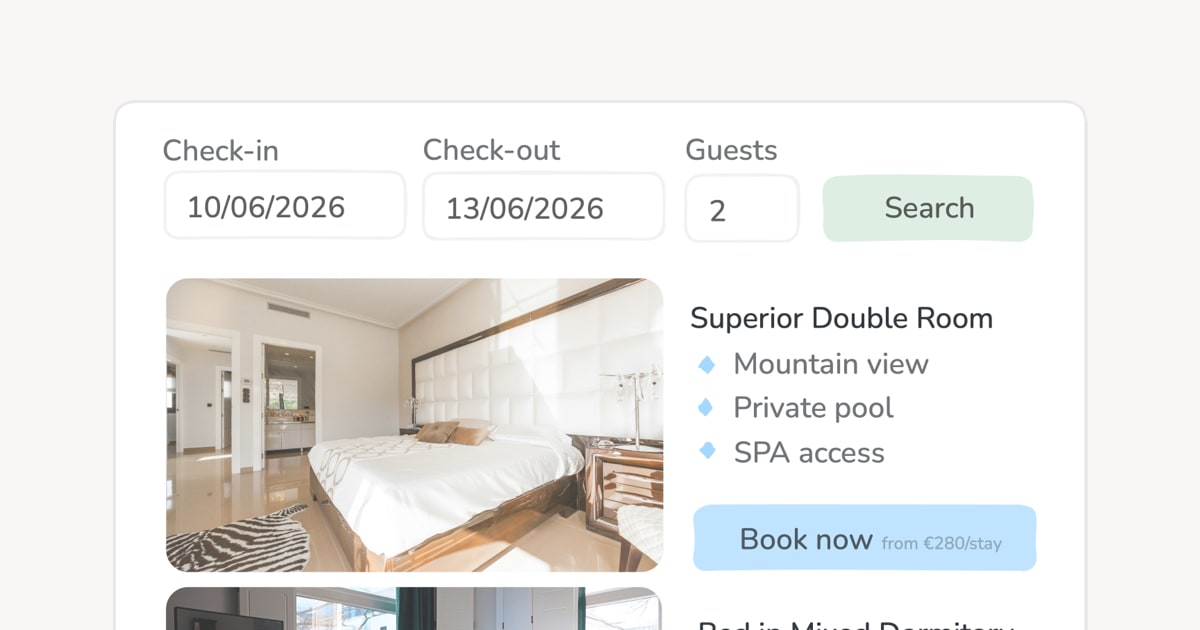
Every booking that comes through an OTA takes a cut before the guest even arrives. Commissions usually sit between 15% and 25% per reservation, and for properties with tight margins, that hit adds up quickly. In many cases, it is the difference between ending the month in profit or just breaking even.
At the same time, guest expectations are higher than ever. A traveler booking a weekend stay on their phone has likely used Airbnb, Booking.com, and multiple airline apps that same day. They know what smooth checkout feels like. If your website needs too many steps or any back-and-forth support to finish a reservation, most guests will leave and book elsewhere, often on the same OTA that charged you to bring them there.
This guide explains what it really takes to grow direct bookings in 2026. Not generic book direct advice, but the practical system behind it: how a channel manager protects availability, how a booking engine converts visitors into paying guests, and how a PMS delivers a consistent experience through checkout. The rest of this content cluster dives deeper into each part; this article gives you the full picture.
Why direct bookings matter more than ever
Independent properties are being pushed toward direct bookings by two clear forces:
-
The OTA squeeze
Commission rates have not meaningfully dropped, and in many regions OTAs now charge additional visibility fees on top of base commission for stronger placement. A guesthouse selling a 100-euro room may keep only 75 to 80 euros before payment processing costs. Across a full season, the cost of relying too heavily on OTAs becomes impossible to ignore. -
The modern guest expectation
Travelers are not benchmarking your site against other small hotel websites. They are comparing it to the best apps they use every day. That means your load speed, mobile UX, and checkout flow are judged against products built by teams obsessed with conversion. If your booking experience feels slow or outdated next to Booking.com, guests will drop off even when your rate is better.
The good news: you do not need to abandon OTAs. You need a direct-booking setup that removes the reasons guests choose OTAs by default: uncertainty, slow checkout, and no clear advantage to booking directly.
Stop losing direct traffic to double bookings
Before you can convert direct traffic, your inventory must be accurate everywhere you sell. That is the channel manager's job, and it is often where independent properties lose bookings without noticing.
Real-time two-way sync
A channel manager with proper API connections, not just a basic iCal feed, updates availability both ways in real time. If a guest books on your website, that room or bed is removed from OTA inventory within seconds. If a booking arrives from an OTA, your direct engine and calendar update just as quickly.
This matters for two reasons. First, it prevents overbookings, which cost money through compensation, damaged trust, and OTA penalties. Second, it protects direct demand. If your site shows availability that was just sold on Booking.com, the guest who hits an error is unlikely to retry. Next time, they will book through the OTA from the start.
For a deeper breakdown of iCal vs API syncing, see iCal vs. API connections: why simple calendar syncing is killing your revenue. If you are setting up channels for the first time, start with the beginner's guide to channel management.
Rate parity, and where you can still stand out
Most OTA contracts include rate parity clauses: your public direct rate cannot be lower than the OTA rate. Breaking parity can get you pushed down in rankings or removed from a channel, so this is not something to test.
What parity usually does not restrict is added value. You can keep the same rate and still make direct booking more attractive with perks OTAs do not include: a welcome drink, early check-in (when possible), a second-night discount, or another low-cost benefit that feels meaningful. The price stays equal but the perceived value is higher, and that is what drives direct bookings.
The toolkit: building a booking engine that actually converts
Getting guests to your website is only half the job. Your booking engine still has to convert that visit into a completed reservation, and this is where most revenue is won or lost.
Speed and a short, clear flow
Every extra step in checkout increases drop-off risk. A strong booking engine takes guests from search to confirmation in three steps or fewer: choose dates and room, add extras, pay. No forced account creation, no unnecessary fields, no pages that crawl on mobile data.
If your property has standout units, your guest-facing room display also affects conversion. The right setup depends on whether your rooms are interchangeable or distinct. This practical guide to room display strategy shows when to list by room type and when to show individual rooms.
Speed is not optional. Guests judge professionalism by how the booking flow performs, and a slow or buggy checkout creates trust issues at the worst possible moment. Bugs, errors, and slow load times are not just frustrating, they are a direct hit to your revenue.
Practical tip: set only essential fields for the booking form. Make sure all fields can be auto-filled on mobile, and test the flow on a low-speed connection to see how it performs for guests with limited bandwidth.
If your current setup needs a technical review, what is a hotel booking engine? How it works and why it matters explains what a modern engine should include.
Trust and transparency at checkout
A guest who does not know your property is taking a perceived risk by booking direct instead of through a familiar OTA brand. Reducing that risk is the key to conversion. A booking engine that builds trust at every step of checkout will outperform one that simply asks for payment.
- Integrated, secure payments. Show a trusted processor, visible security cues, and avoid confusing redirects to unknown third-party pages.
- A clear price breakdown. Before confirmation, show exactly what is included: room rate, city tax, cleaning fees, extras, and total.
- Visible policies. Make cancellation rules, check-in/check-out times, and house rules easy to find during booking.
- Clear next steps. After payment, explain what happens next, when communication will arrive, and how to contact the property.
Many of these trust-building elements are standard on OTAs, and guests expect them. If your direct booking flow lacks any of these, it is a conversion risk.
Localization: language and currency
A booking engine limited to one language and one currency effectively excludes part of your audience. Letting guests browse and pay in their own language and currency removes unnecessary barriers right when they are deciding whether to trust your site with payment details.
This is important especially for hostels and hybrid properties with international demand, where limited localization can be a major conversion barrier.
Add-ons that increase the booking value
A good booking engine captures reservations and helps guests build their stay. Offering add-ons like breakfast, parking, airport transfer, or local tours during checkout, with clear pricing, lifts average booking value without creating extra front-desk work.
Guests are more likely to add extras during initial booking than later by email because intent and payment are already in place.
Beyond checkout: what the OTAs give you for free
Rate parity is a constraint, however OTAs still introduce your property to new guests. A well-optimized Google Business Profile plus Google Hotel Ads can capture part of that same demand directly, often at a lower cost per booking than OTA commission.
This is the billboard effect: guests discover you on an OTA, then search your brand and book on your site. Showing direct rates and live availability next to your Google listing helps close that loop.
The backend: how the PMS carries the promise through
A fast, trustworthy booking engine gets guests in the door. What happens next depends on your PMS, and that experience directly affects whether guests book with you again.
Hybrid inventory, handled properly
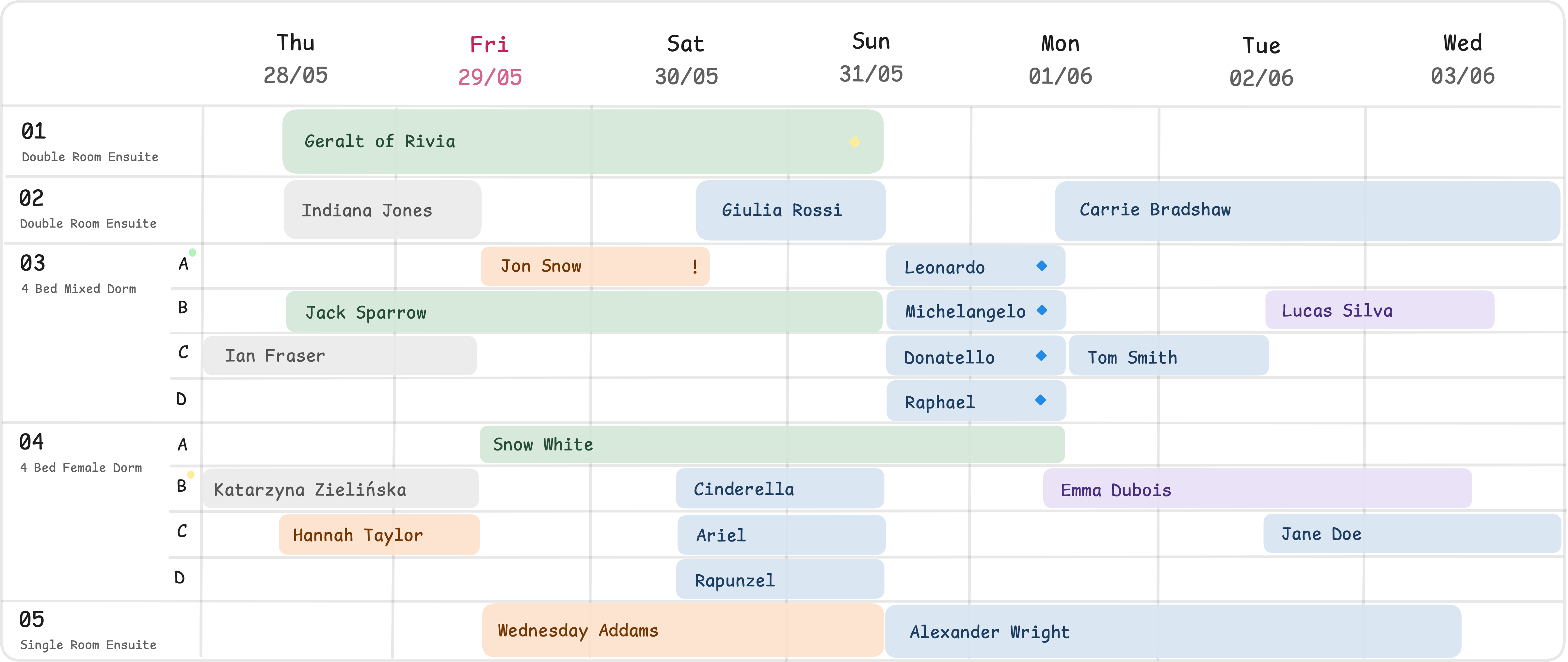
Properties that sell both private rooms and shared dorm beds face a specific challenge: many systems handle one model well and the other poorly. A PMS built for hybrid inventory manages room-level and bed-level availability in one calendar, without manual blocking or spreadsheet fixes whenever a dorm group books out. Guests booking a bed directly should get the same smooth flow as guests booking private rooms.
For more details, see our blog post on managing private rooms and dorm beds in one system. If you run a hostel, learn more about how a booking engine helps hostels cut OTA commissions.
Fast operations at the front desk
If a guest books direct and then waits fifteen minutes at check-in because staff are struggling with a slow PMS, the direct promise is broken. A clear room calendar and efficient front-desk workflows keep arrivals fast, especially on high-turnover days when operational speed matters most.
Point of sale and billing, in one place
Once guests are on-site, they often spend more: late checkout, bar items, snacks, local services. When POS and billing are integrated with reservations in the PMS, charges are posted automatically to the guest folio instead of reconciled manually later. The final invoice is cleaner and more accurate, and that clarity supports trust the same way transparent pricing does during booking.
Conclustion: direct bookings are a system, not a single tool
These three layers only work when connected. A polished booking engine with a channel manager that syncs once daily will still overbook. A perfectly synced channel setup feeding a five-step checkout will still lose guests at payment. And a fast booking flow paired with a PMS that lacks complete guest data will still create confusion at checkout.
Properties that consistently win back share from OTAs treat direct booking as one system: accurate availability, a checkout built for speed and trust, and backend operations that deliver what was promised. If you are assessing gaps in your current setup, booking engine vs. OTA: the ROI calculator for independent properties is a practical next step for modeling your own mix.
Read next
- What is a hotel booking engine? How it works and why it matters
- How a booking engine helps hostels cut OTA commissions
- Google Hotel Ads for beginners: is it worth the investment for small properties?
- The beginner's guide to channel management: syncing OTAs in 2026
- The hybrid property: managing private rooms and dorm beds in one system
- Booking engine vs. OTA: the ROI calculator for independent properties
- Website design tips that actually increase direct bookings in 2026
- Room display strategy for direct bookings