Google Hotel Ads for beginners: is it worth the investment for small properties?
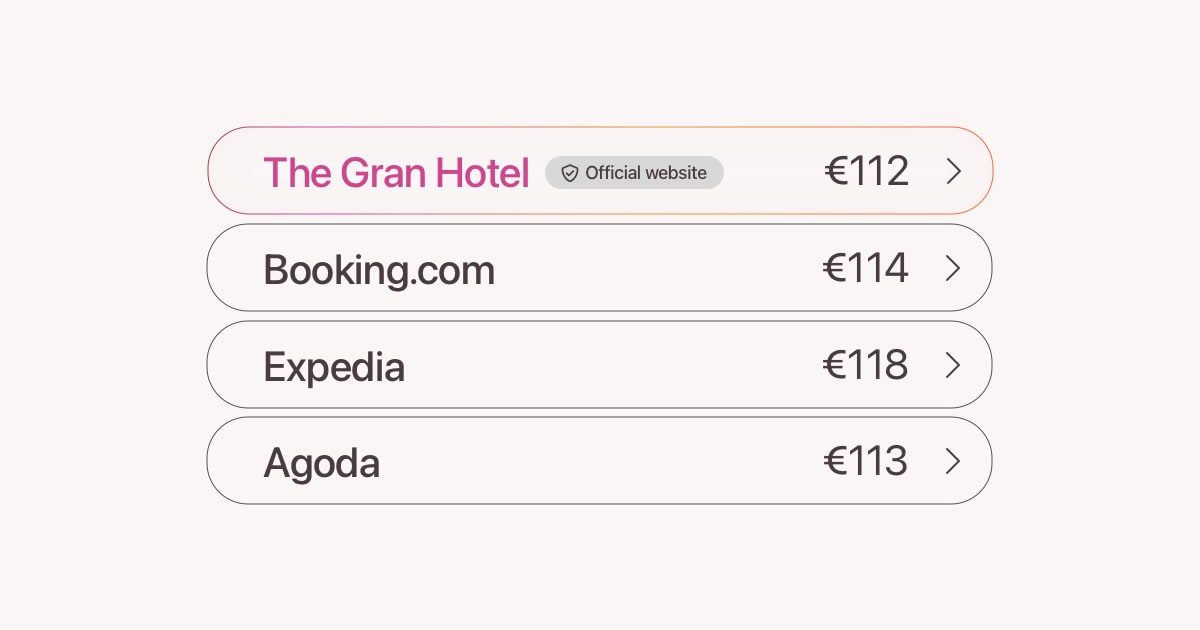
When someone searches "guesthouse in Lisbon" on Google, they don't land on your website. They land on a panel showing live rates from Booking.com, Expedia, and whoever else is bidding. Every time a guest finds you on Google but clicks a Booking.com link to reach you, you lose 15 to 20% of that reservation's value. Google Hotel Ads is how you stop that leak.
This guide explains how the system works, what it costs, and if the numbers make sense for a small property running on a lean marketing budget.
For the bigger direct-booking strategy around this channel, read the full 2026 direct bookings guide.
What Google Hotel Ads actually are
Google Hotel Ads is a metasearch advertising product. Metasearch sits between traditional search (Google Search, where you rank organically) and OTAs (where you list your rooms). The key distinction is that metasearch doesn't process the booking itself. It displays your rates and links the traveler directly to wherever you want them to book, including your own website.
When a traveler searches for accommodation in your destination, Google shows a hotel panel near the top of the results page. That panel pulls live rates from OTAs and, if you've connected your booking engine, from you directly. Your rate appears alongside Booking.com's rate and Expedia's rate. The traveler picks one and clicks through.
If they click your direct booking link, they arrive on your site and book there. No OTA commission. The booking, the guest's contact details, and the relationship belong to you.
This is fundamentally different from regular Google Ads, where you're bidding on keywords to appear in standard search results. Google Hotel Ads shows up specifically in the hotel search module, and your listing is populated with real-time prices and availability from your property management system or booking engine.
Free booking links: the part most small properties miss
Before getting into paid ads, it's worth understanding that Google offers a free tier.
Since 2021, Google has allowed hotels to display free booking links in their hotel profile. These are organic placements, not paid ones. When a traveler pulls up your property on Google, your direct booking rate can appear alongside the OTA rates at no cost.
To activate them, you need two things: a verified Google Business Profile, and a connectivity partner (a booking engine or channel manager that's integrated with Google's Hotel Center). Once those are connected, your rates and availability sync to Google automatically, and the free links go live.
The catch is visibility. Free booking links don't get the same placement as paid Hotel Ads. Paid placements appear first in the panel, and OTAs with large budgets dominate those top spots. If someone searches for your property by name and finds the hotel panel, your free link will appear. But for generic searches ("boutique hotel in Ghent") the paid advertisers push the free links further down.
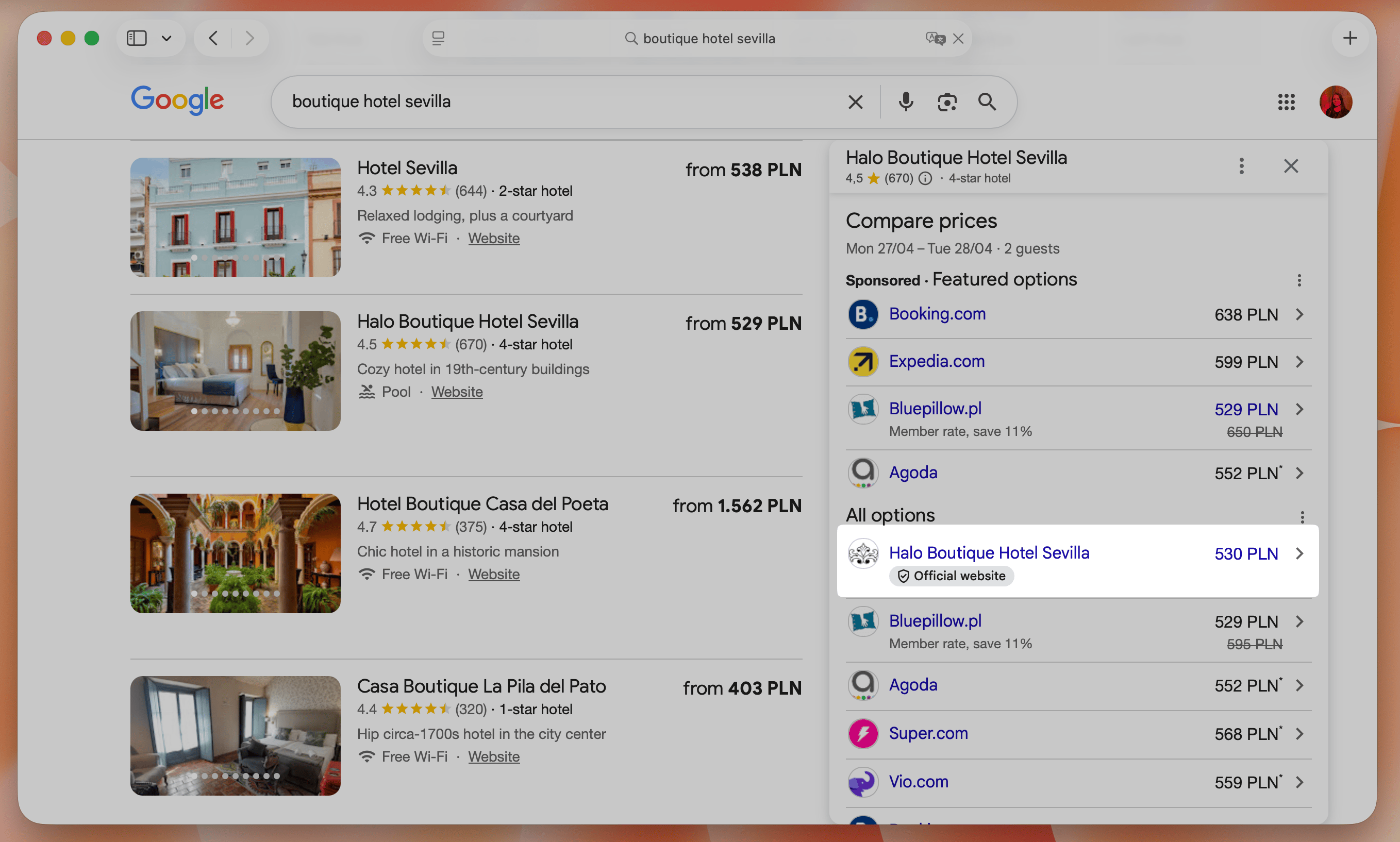
Still, free booking links are worth setting up. They're a baseline with no ongoing cost, and any direct bookings they generate are pure margin. Think of them as the floor, not the ceiling.
| Free booking links | Paid Hotel Ads | |
|---|---|---|
| Cost | €0 | CPC (bidding model) |
| Placement | Lower in panel / "All options" tab | Top of the panel |
| Reach | Direct brand searches | Generic searches ("hotel in Paris") |
| Best for | Baseline visibility | Aggressive direct growth |
How the paid ads work
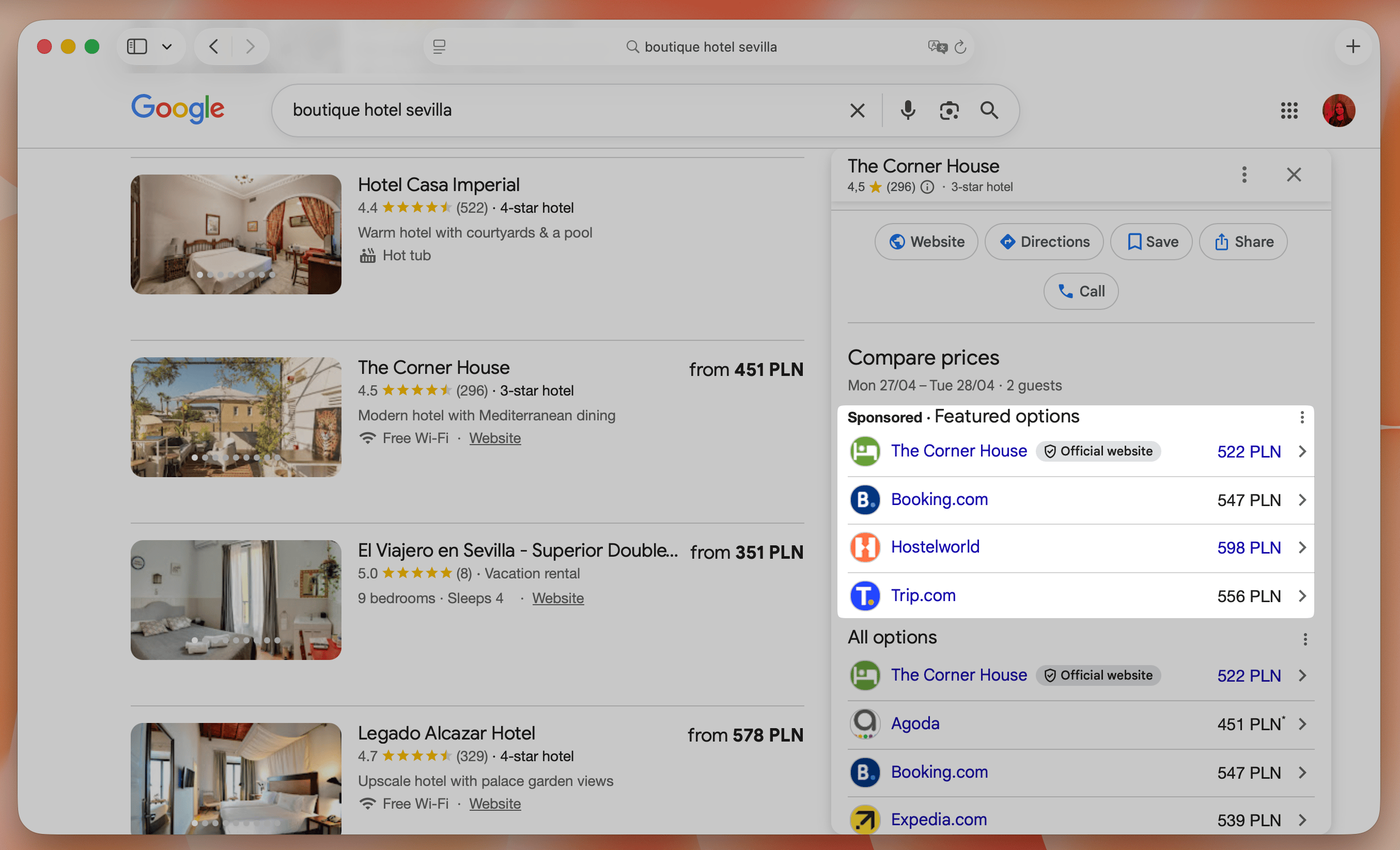
Paid Google Hotel Ads run on a cost-per-click (CPC) model, meaning you pay each time a traveler clicks on your listing. You set a budget and a maximum bid, and Google enters your property into a real-time auction every time a relevant search happens.
A few things determine where your ad appears: your bid amount, your price competitiveness compared to OTAs, your review score, and the quality and completeness of your property profile. A small property with excellent reviews and a competitive rate can outbid a chain hotel on specific searches.
It's worth noting that 2025 brought a significant change to this market. Google had previously offered commission-per-stay models (you only paid when a guest actually checked out), which were popular with smaller hotels because they removed the risk of paying for clicks that didn't convert. Google phased those commission-based bid strategies out in early 2025, and the current options are CPC bidding, Target ROAS (where Google's algorithm optimizes bids toward a revenue target), and Performance Max campaigns.
One more reason this matters in 2026: Google's AI-powered search results now prominently surface the hotel panel when travelers ask for accommodation recommendations. If you're not in the auction, AI-generated travel suggestions are even more likely to route guests toward whichever OTA is bidding, not toward you.
For a beginner at a small property, CPC bidding is the most straightforward place to start. You set a daily budget, a maximum cost per click, and you can pause or adjust at any time. Performance Max campaigns, which Google is pushing increasingly hard, require more budget and data to work well; they're worth exploring later, but they're not the right entry point for a property just getting started.
What it costs in practice
There's no minimum spend for Google Hotel Ads. You can run a campaign on €5 per day if you want to, though you'd get limited visibility at that level.
In practice, small properties tend to start somewhere between €200 and €500 per month to see meaningful data and traffic. The actual cost per click varies significantly by destination, season, and competition. High-demand city centres at peak season cost more per click than a rural guesthouse in the off-season.
To understand if that spend makes sense, the comparison point is OTA commission.
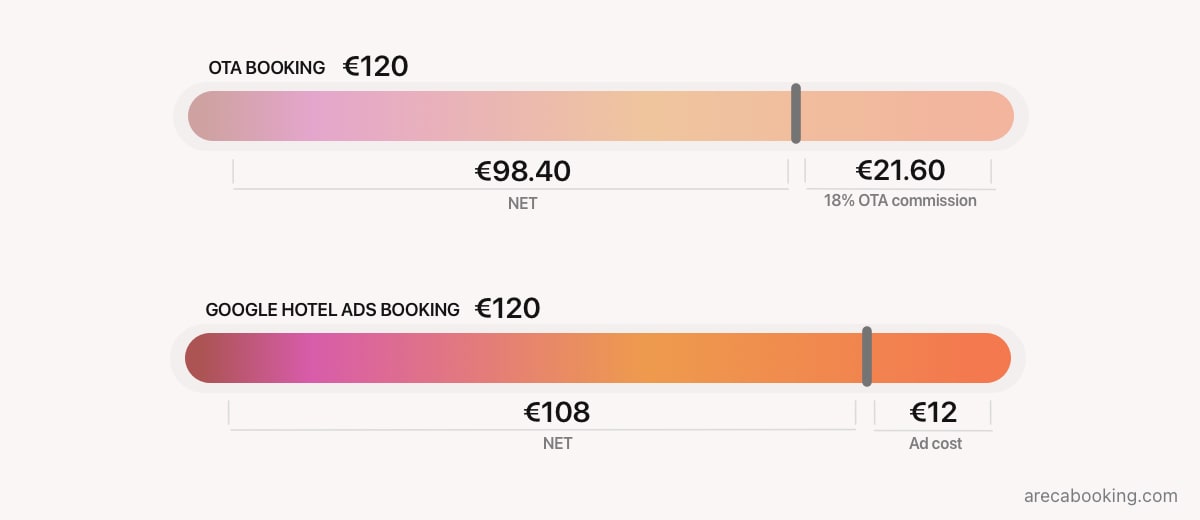
Here's a simple example. Say your average room rate is €120 per night. Booking.com takes 18% commission, which is €21.60 per booking. If you can acquire a direct booking through Google Hotel Ads for a total ad cost of €12 to €18, you're already ahead of the OTA economics, and you keep the guest data.
The calculation that matters is cost per acquisition (CPA): how much do you actually spend in ad clicks to generate one completed booking? If your click costs €1.50 and 8 out of 100 clicks convert to a booking, your CPA is around €19. At a €120 room rate, that's still cheaper than the €21.60 OTA commission, and you own the guest relationship from that point forward.
The math varies by property. Higher average rates, longer stays, and repeat guests all improve the return. Properties with low average rates and very high OTA market share may find the entry costs harder to justify until they have volume.
Check out also our ROI calculator to see how direct booking channels can impact your bottom line over time.
What you need before you start
Google Hotel Ads aren't a plug-and-play product. There are a few prerequisites that are easy to overlook.
-
A booking engine connected to Google.
This is the foundational requirement. Your booking engine or channel manager needs to be a Google connectivity partner, able to send your live rates and availability to Google's Hotel Center. Integration timelines vary: older or more complex setups can take three to nine weeks, while modern platforms like Areca have made this much quicker. If your booking engine isn't connected, you can't participate in Hotel Ads at all. When evaluating booking engine options, this is one of the practical questions worth asking upfront. -
A verified and complete Google Business Profile.
Your property profile is what Google displays alongside your rates. Incomplete profiles perform poorly in the auction. You need current photos, accurate amenities, and active review management. A property with 4.6 stars outcompetes one with 3.8 stars, even with identical bids. -
A fast, mobile-friendly booking page.
People click through from Google on mobile constantly. If your booking page is slow or confusing, they abandon and go back to Booking.com. The click cost is already spent at that point, so your website conversion rate directly affects your ad ROI. If you're investing in Hotel Ads, your booking page needs to be ready to receive the traffic. -
A Google Ads account.
You'll manage campaigns through Google Ads, so you'll need an account set up and linked to your Hotel Center property listing.
Who benefits most from Google Hotel Ads
Not every small property is in the same position when it comes to Google Hotel Ads.
-
Properties in destinations with high organic search volume, meaning places travelers actively look up, tend to see the best returns. A boutique guesthouse in Porto, Bruges, or Tbilisi benefits more than a rural retreat that most travelers discover through editorial lists or word of mouth.
-
Properties with strong review scores get better returns on their ad spend because Google factors review quality into placement. If you're already at 4.5 or above and responding regularly to reviews, you're in a better position than a competitor with a higher bid and a 3.9 average.
-
Properties that already have a functioning direct booking channel get more from Hotel Ads because the ad is driving traffic to a conversion-ready destination. If your website doesn't have a clear booking flow, Hotel Ads will generate clicks that don't convert.
Hostels and dorm-focused properties face a slightly different dynamic. Google Hotel Ads is built around room-rate display and works best when you can show a clean per-night rate. Dorm beds can be listed, but the presentation is less intuitive than for private rooms. The core mechanics still apply, but it's worth verifying how your booking engine handles this before assuming the setup will be smooth.
The realistic picture for a beginner
The first month of running Google Hotel Ads is primarily about data collection, not returns. You're learning your click costs, your conversion rate, and which search terms bring the best traffic. Don't evaluate the investment after two weeks.
Ad costs in metasearch have increased significantly, with some hoteliers reporting year-over-year ad spend increases of 20 to 40 percent due to heightened competition. OTAs spend enormous sums on Hotel Ads, and they're better at it than a new campaign run by a property manager learning the platform on the side.
That's not a reason to avoid it, but it is a reason to be realistic. Starting with a small, controlled budget and clear tracking in place is better than going in with a large spend and no way to measure what's working.
The most common mistake beginners make is running Hotel Ads without tracking direct bookings back to the campaign. If your booking engine doesn't pass conversion data back to Google Ads, you can't see your actual CPA, and you're flying blind. Make sure this is set up before you spend a cent.
If managing campaigns feels like too much to add to an already full plate, many booking engine providers and channel managers offer managed Google Hotel Ads as part of their service. You hand over the campaign management and pay a service fee. If that's worth it depends on the volume of bookings you expect to drive, but for a property doing fewer than 20 or 30 direct bookings a month, the time spent learning the platform yourself is often reasonable.
Where Google Hotel Ads fits in a broader direct booking strategy
Google Hotel Ads is one part of a larger picture. It works best when the other pieces are in place.
The billboard effect is relevant here: travelers often discover a property on an OTA, then search for it directly to find a better rate. Google Hotel Ads is what captures that search intent and converts it into a direct booking. If you're not in the panel, the traveler clicks the OTA listing they already have open.
Combined with a well-structured direct booking incentive program and a booking engine that presents rates clearly, Google Hotel Ads becomes a meaningful channel for reducing OTA dependency over time. The goal isn't to eliminate OTAs entirely. It's to make sure that travelers who want to book with you directly have a clear, easy path to do so, and that you're visible at the moment they're looking.
If you haven't set up your direct booking infrastructure yet, that's the right starting point. A booking engine that's connected to Google, loads quickly on mobile, and gives guests a reason to book direct is the foundation that makes Hotel Ads worth running. If that's already in place, adding Google Hotel Ads to the mix is one of the more logical next steps toward reclaiming a percentage of your bookings from OTA commission.