How a Booking Engine helps hostels cut OTA commissions and win direct bookings
Every time a guest books your hostel through Hostelworld, Booking.com, or Expedia, you hand between 15% and 30% of that booking straight back to the platform. On a €30 dorm bed, that's up to €9 gone before you've even welcomed the guest. Multiply that across a season and the number gets uncomfortable fast.
A booking engine doesn't replace OTAs, they're still a valuable source of new guests. But it gives you a direct channel that costs you nothing in commission, and over time, shifts the balance in your favour.
This guide covers what a hostel booking engine does, the features that matter for dorm-based properties, and what to look for when choosing one. It also shows how the Areca booking engine sells dorm beds and private rooms side by side.
If you want the bigger strategy behind these decisions, read the full direct-bookings playbook for 2026 for a complete view of how channel management, the booking engine, and PMS operations work together.
What is a hostel booking engine?
A booking engine is software on your website that lets guests check availability and reserve directly, without going through a third-party platform. It shows live availability, takes the reservation, and sends it to your property management system (PMS) automatically.
A hostel booking engine does the same job, but it sells beds as well as rooms. Dorm beds, female-only rooms, mixed dormitories, and per-bed pricing all need logic that most hotel-focused tools don't support out of the box.
Why direct bookings matter more for hostels than for hotels
Hotels typically earn more per room, which makes OTA commissions easier to absorb. Hostels run on tighter margins: you're selling beds, not rooms, often at €15-€50 per night. A 20% commission on a €20 bed is €4. That may not sound like much, but across 20 beds a night for 200 nights a year, it's €16,000 you didn't need to give away.
Beyond the maths, direct bookings give you something OTA bookings don't: a guest relationship. You know who's coming, you can write to them before arrival, you can offer add-ons, and you can encourage them to come back and book direct next time.
What a booking engine does for your hostel
Reduces OTA commission costs
Every direct booking is a booking you didn't pay commission on. Some booking engines charge a flat monthly fee, some take a small fee per booking, and some are included with the PMS. All of these cost far less than the 15-30% OTAs take. Over a full season, even a modest shift toward direct bookings can pay for the tool several times over.
Gives you control over pricing and policies
With a booking engine, you set the rates. You can run early bird discounts, last-minute deals, minimum stay rules, or non-refundable rates on your own terms, without OTA approval or rate parity clauses.
Enables upselling before arrival
The booking process is one of the best moments to offer extras: a private locker, linen hire, a walking tour, airport transfer, or breakfast. OTAs rarely give you this opportunity. Your own booking engine does. Guests who are already planning their stay are open to small additions that improve it and increase your revenue per booking. You can keep selling after arrival too, see front desk upselling.
Prevents double bookings in dorms
A booking engine that is connected to your PMS and channel manager updates bed availability across all channels. When a bed is sold, it's gone: on your site, on Hostelworld, on Booking.com, everywhere at once. This matters most for hostels that manage female-only dorms, mixed dorms, and private rooms at the same time, where one mistake means a guest without a bed.
Collects guest data you own
OTAs often hide guest contact details. Your booking engine gives them to you. That means email addresses and booking history you can use for pre-arrival messages, review requests, and offers for the next trip.
Speeds up check-in
A booking engine can collect the details you need at the time of booking: nationality, date of birth, ID document number, or arrival time. For a busy hostel in peak season, fewer paper forms at the front desk means shorter queues and a better first impression.
Hostel-specific features to look for
Not every booking engine is built for hostel operations. When you compare options, make sure the tool handles the following:
-
Per-bed booking and dormitory management.
You need to sell individual beds, not just rooms, with a price per bed. The system should handle male, female, and mixed dorms and never sell more beds than a dorm has. -
A choice between room types and specific rooms.
Some hostels want guests to book "a bed in a 6-bed mixed dorm". Others want guests to pick the exact room and bed. This room display guide explains when each option works better. -
Group booking support.
Hostels regularly take groups: sports teams, school trips, stag parties. Your booking engine should let one person book several beds and rooms in a single reservation. -
PMS integration.
A booking engine that doesn't talk to your PMS creates double-entry work and overbooking risk. Look for a booking engine built into the PMS or a reliable API connection to your existing system. -
Mobile-first design.
Many hostel guests are younger travelers booking on their phones, often at short notice. If the booking flow isn't fast and clean on mobile, you'll lose them. -
Multi-language and multi-currency support.
Hostels serve international guests. A booking engine that speaks the guest's language and shows prices in their currency makes booking easier for them. -
Promo codes and rate plans.
You should be able to run direct-booking incentives, such as exclusive rates or discount codes, that exist only on your own website and never appear on OTA platforms. -
City tax handled for you.
Tourist tax per guest and per night is easy to get wrong in a dorm. The booking engine should calculate it and show it to the guest before they confirm. -
Payment options that fit your hostel.
Many hostels take payment on arrival, others ask for a deposit online. Check which options the tool supports today and which payment providers it works with. -
Simple website integration.
The booking engine should fit into your existing site with a search widget or a "Book now" button, and work as a standalone booking page if you don't have a full website yet.
How Areca's booking engine works for hostels
Areca is a PMS built for properties that sell both beds and rooms, and the booking engine is part of it. This section covers what matters for a hostel. For a walk-through of every setting, including branding, the guest form, and the website widget, see how the Areca booking engine works in our general guide.
Dorm beds sold per bed
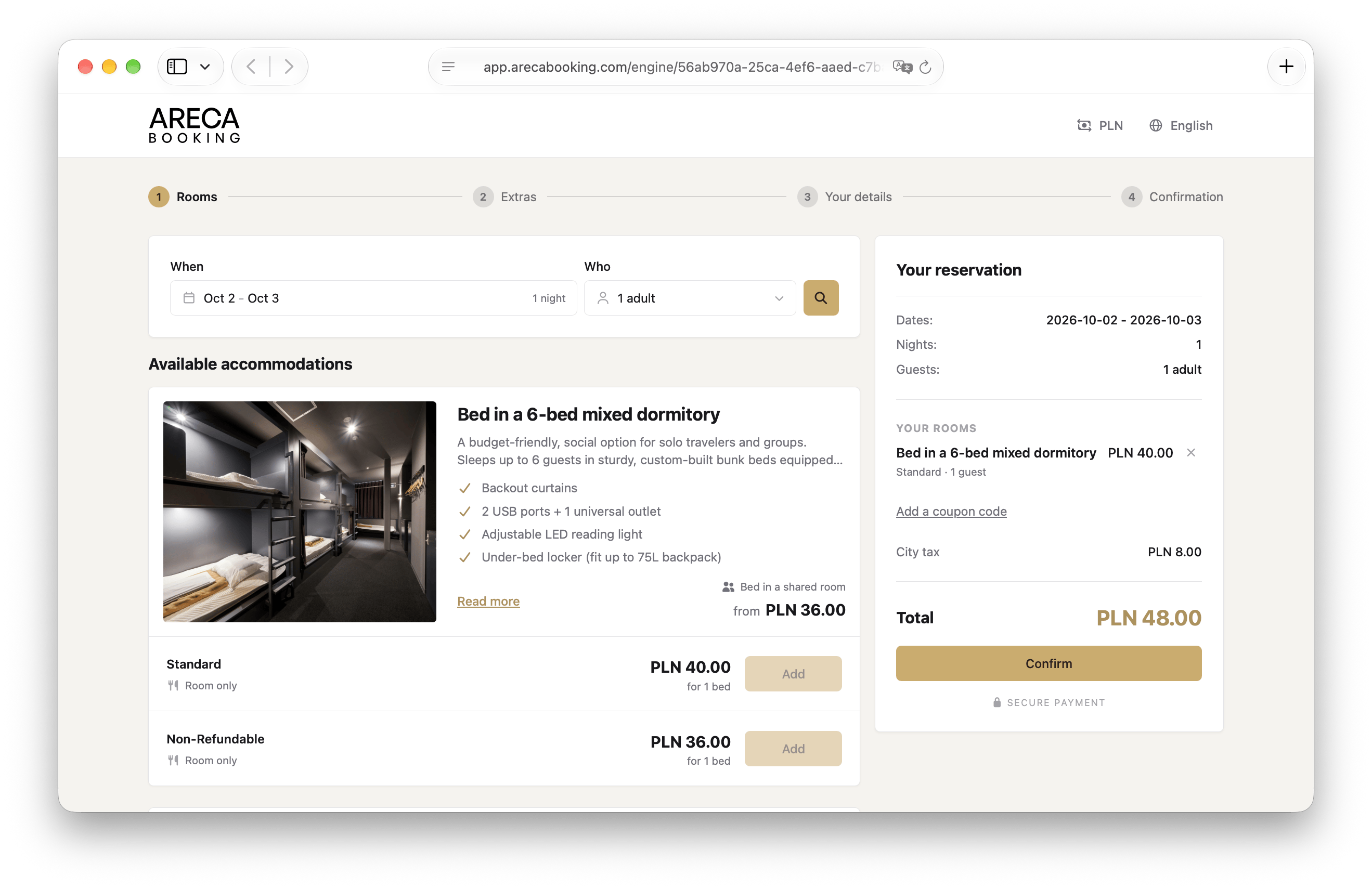
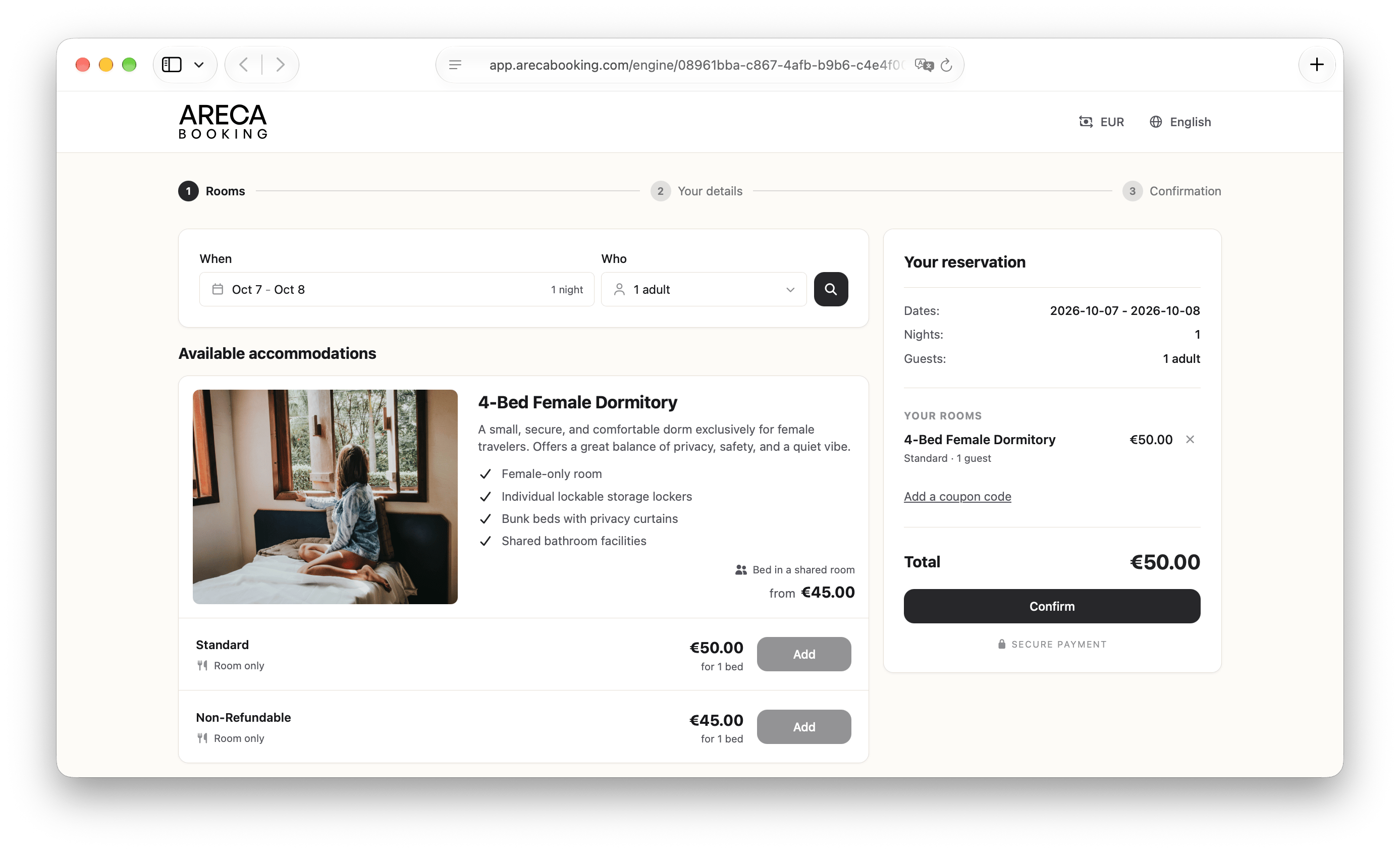
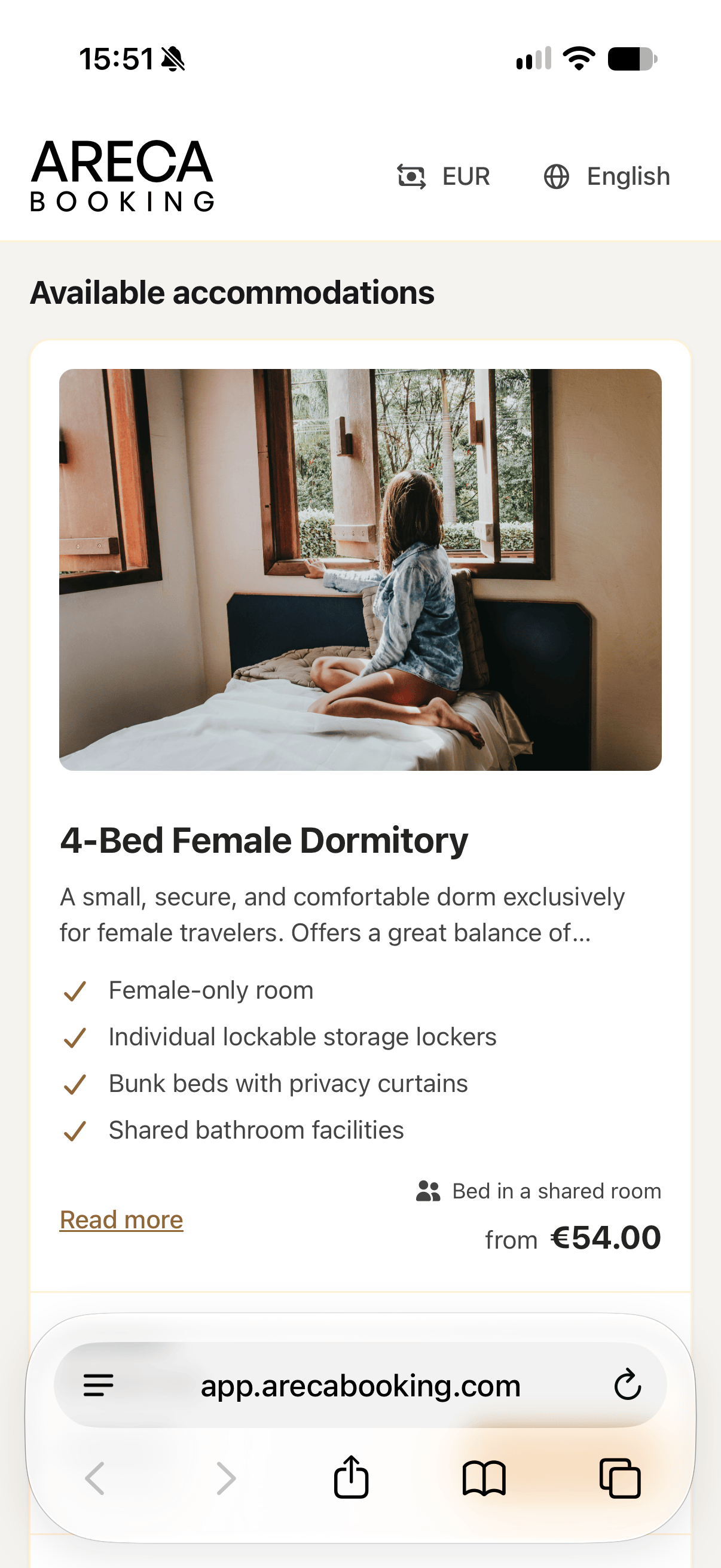
A shared room is sold as single beds, each with a per-bed price, and it sits next to your private rooms in the same search results. The room card tells the guest clearly that it is a bed in a shared room, and the price is shown per bed. A group can add several beds and a private room to the same reservation.
A bed in a dorm type, or one exact bunk
There are two ways to sell a dorm. In the default mode the guest books "a bed in a 6-bed mixed dorm" and Areca picks a free bed. This is the quickest option for the guest and gives you the most freedom on the calendar.
In the second mode you list specific rooms. The guest opens a dorm, sees its beds, and chooses one, like the lower bunk by the window. Friends travelling together can take beds in the same room. You switch between the two modes with one setting.
Deals that stay off the OTAs
A coupon code only works in your own booking engine, so the discount never appears on Hostelworld or Booking.com. Some ways hostels use them:
- A code on a card at reception for guests who came through an OTA, to use on their next stay.
- A code in your Instagram bio or stories for a quiet week.
- A code for stays of three nights or more in low season.
- A code with a limited number of uses for a festival or a partner event.
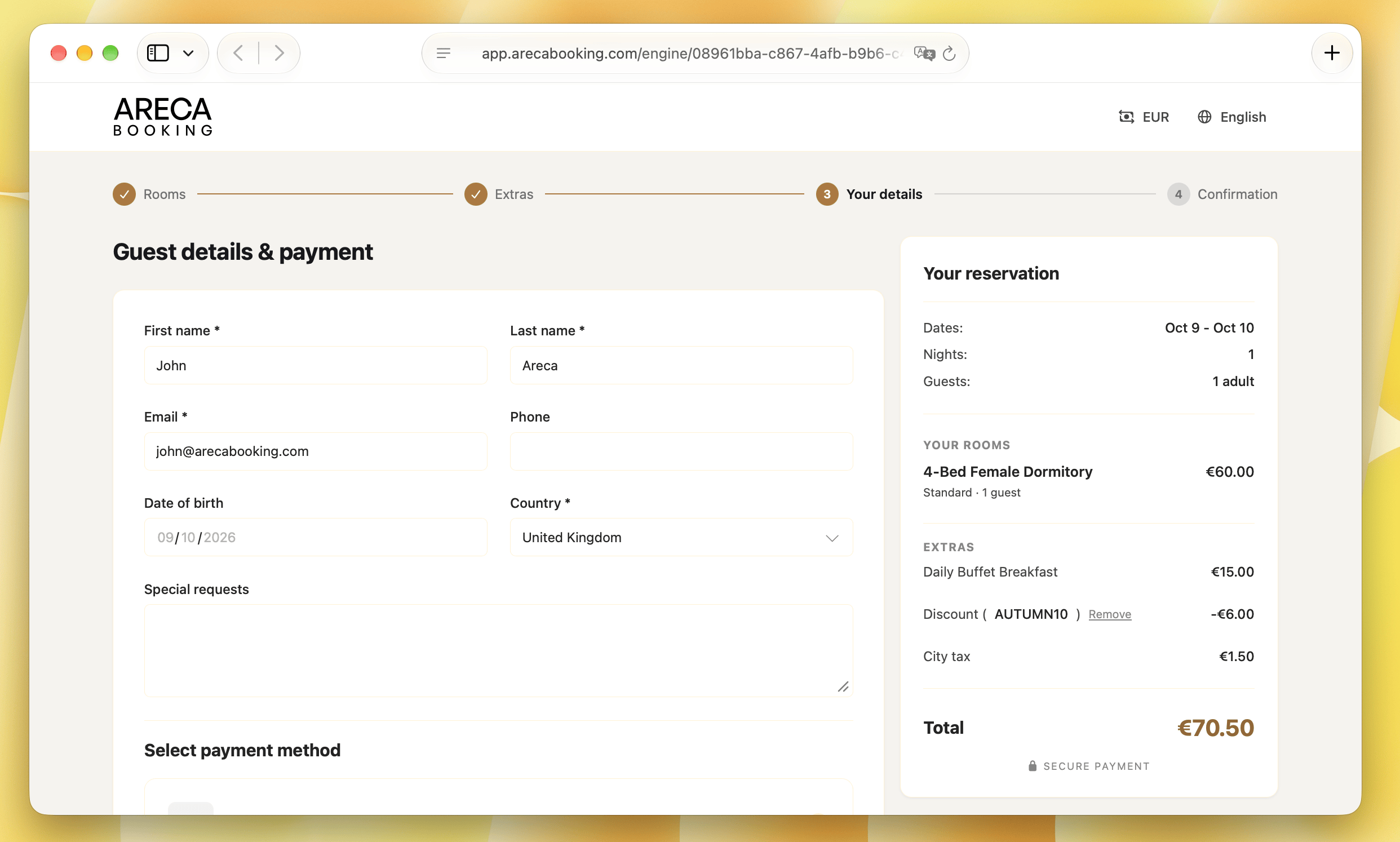
The discount shows as a separate line in the guest's summary, so they can see what the code saved them.
Lockers, towels, breakfast, and city tax
Small extras add up in a hostel. You can offer a locker, towel rental, breakfast, or a pub crawl during booking and choose how each one is charged. A breakfast at €6 per person per night for two guests staying three nights is added as €36, with no maths at the front desk.
City tax is calculated for everyone in the reservation and listed in the summary before the guest confirms, so nobody is surprised by an extra charge at check-in.
Travellers from everywhere
Hostel guests come from all over the world. The booking engine is available in seven languages, including Spanish, German, and French, and the guest picks one at the top of the page. A traveller from the UK can check your prices in pounds as an estimate, while the booking itself is still made in your currency.
Made for booking on a phone
Most hostel guests book on their phone, often the same day. The booking engine adapts to the screen, so photos, room details, and prices stay easy to read and the whole booking can be finished with one hand.
On your website, Instagram, and Google
The website widget puts a date search on your site as a horizontal bar or a vertical panel. If you don't have a website, you can share a direct booking link in your Instagram bio or Google Business Profile. Links can carry dates, the number of guests, or a coupon code, so a story about a weekend deal opens that exact offer.
What happens after the booking
The reservation appears on your calendar right away, with the bed already assigned, and the guest gets a confirmation email you can edit. With the channel manager connected, the bed is closed on Hostelworld, Booking.com, and your other channels automatically.
Guests don't enter a card when they book. They pay at reception when they arrive, which is how many hostels work anyway. Card payment at the time of booking is on the roadmap, with Stripe and PayU as the first providers, but it is not live yet.
What it costs
The booking engine charges 0% commission and no per-booking fees. It is included in every Areca plan, including the Free Forever plan for hostels with up to 8 beds. See the pricing page for details.
OTAs and direct bookings: not either/or
A booking engine doesn't mean abandoning OTAs. Platforms like Hostelworld and Booking.com are still valuable for discovery: they introduce guests to your property who would never have found you otherwise. The smart approach is to use OTAs to win new guests and your booking engine to bring them back.
When a guest books through an OTA and stays with you, that's your opportunity. Give them a great stay and a reason to book direct next time: a coupon code, a guaranteed bed type, or simply the knowledge that booking direct is cheaper and easier.
Over time, the share of your bookings coming through direct channels should grow. Your booking engine is what makes that possible.
Getting started
Most modern booking engines can be set up and added to your website within a day or two. The key steps are:
- Set up your dorms, private rooms, and beds in the PMS.
- Create your rate plans and prices.
- Choose your room display setup: room types or specific rooms and beds.
- Pick which rooms, rate plans, and extras are sold online, and add photos.
- Match the colors, fonts, and logo to your brand.
- Add the widget or a "Book now" button to your website and the link to your social profiles.
If you're comparing options, look for a tool built for hostel operations, one that treats dorm beds as a core feature and not as an add-on to hotel software.
Frequently asked questions
Can a hostel booking engine sell individual beds?
Yes, if it is built for hostels. Areca sells each dorm as single beds with a per-bed price and keeps count of how many are free, so a dorm is never sold beyond its capacity.
Can guests choose their exact bed?
In Areca they can when you sell specific rooms. Guests pick the room and, in dorms, the bed. In the default room-type mode Areca assigns the bed for them.
How do group bookings work?
One guest can add several beds and rooms to a single reservation, even of different types, and book them together in one go.
Do I still need Hostelworld and Booking.com?
Yes. OTAs bring you guests who have never heard of your hostel. The booking engine is for everyone who already knows you: returning guests, social media followers, and people who look you up after seeing you on an OTA.
Does a booking engine work without a website?
Yes. A direct booking link works on its own. Put it in your Instagram bio, Google Business Profile, and messages to guests.
Areca is built for hostels: a commission-free booking engine with per-bed bookings, part of a hostel PMS that manages beds and rooms on one calendar. Try it free →