The beginner's guide to channel management: syncing OTAs in 2026
You listed your property on Booking.com. Then Airbnb. Then Expedia. More visibility arrived, but so did chaos. A room books on two platforms simultaneously. A rate mismatch makes you look unreliable. You spend your mornings logging into four extranets before you can start actually hosting guests.
This is the distribution paradox: the more channels you open to grow revenue, the more operational risk you take on. A Channel Manager (CM) exists to resolve that paradox. This guide explains what a CM actually does, why real-time syncing has become non-negotiable in 2026, and how to build a distribution stack that reaches more guests without creating a management nightmare.
At a Glance: Why this matters in 2026
Manual is dead. Between 2024 and 2025, OTA fragmentation reached a tipping point. Managing multiple platforms by hand now guarantees revenue loss, not just inconvenience.
API beats iCal. If your inventory sync takes longer than 30 seconds, you are at risk. 2026 is the year of push technology. Any CM still relying primarily on iCal polling is a liability.
The real goal is balance. Not just more bookings, but a distribution mix where OTAs provide reach and your direct channel provides margin. Neither alone is a sustainable strategy.
What is a channel manager?
A Channel Manager is the software layer that sits between your property and every Online Travel Agency (OTA) you are listed on. It acts as a single control point for three things: availability, rates, and reservations, pushed simultaneously across every connected platform.
Without a CM, you manage each OTA separately. Log into Booking.com, update availability. Log into Airbnb, update availability. Repeat for Expedia, Agoda, Hostelworld, and every other platform you use. A CM replaces that stack of manual steps with a single action: update once, propagate everywhere.
In 2026, the definition has expanded. A modern CM does not just distribute data outward. It pulls bookings in, connects to your Property Management System (PMS), feeds your own Booking Engine, and increasingly sits at the centre of a revenue management stack that includes AI-driven dynamic pricing and competitor rate monitoring. It has become the operational backbone of any seriously run independent property.
The scale of the problem it solves
The OTA landscape in 2026 is larger and more fragmented than ever. Online channels now account for around 55% of all hotel reservations globally, with that figure projected to reach 65% by the end of the year as mobile-first booking continues to grow. Independent properties are more OTA-dependent than branded chains: OTAs captured 61% of bookings for independent properties in 2024, compared to just 35% for chain hotels that have loyalty programmes and direct-booking infrastructure working in their favour.
In Europe, that dependency is even higher. In 2024, 77% of hotel bookings across the continent arrived via OTAs, the highest regional figure globally. If you run a hostel, guesthouse, or independent hotel in Europe, you are effectively running an OTA-first business, intended or not.
The promise: High occupancy without the nightmare
A well-configured CM is what makes it possible to be listed on eight or ten OTAs simultaneously without a proportional increase in operational complexity. When it is working correctly, you get the distribution benefits of every channel while managing availability, rates, and reservations from one screen. The data supports the payoff: properties report up to a 73% reduction in overbooking incidents within six months of adopting a channel manager, and midscale properties saw 18% growth in direct bookings after integration.
The key caveat, which this guide will return to repeatedly, is that not all channel management is equal. In 2026, a CM built on iCal calendar syncing is a different product from one built on real-time API connections. The technology underneath decides if your sync is "good enough for now" or reliable at scale.
The problem: Why manual management breaks down
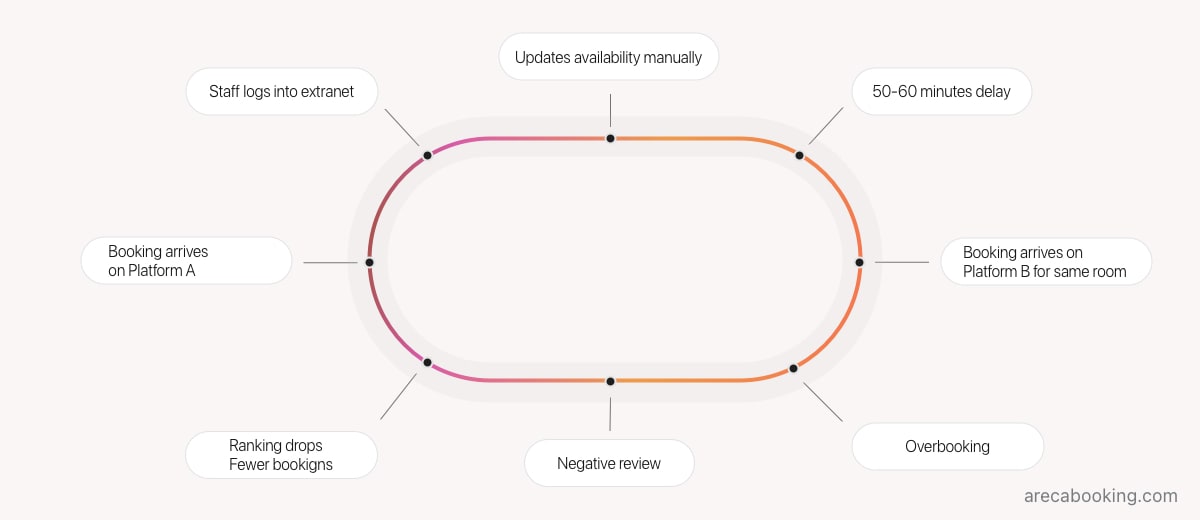
Every OTA you list on has its own extranet: its own interface, its own availability calendar, its own rate controls, its own booking inbox. Managing two platforms manually is inconvenient. Managing six is a part-time job. Managing ten is a source of costly, recurring errors.
The specific failure modes are predictable:
-
Overbookings happen when a room is sold on two platforms simultaneously because the availability update from the first booking has not reached the second platform yet. The guest arrives to find no room. You pay to relocate them and absorb a near-certain negative review.
-
Rate disparity happens when prices drift out of sync across platforms, either through human error during manual updates or through promotional pricing on one channel that was not applied everywhere. OTAs actively monitor for rate parity violations and will demote or penalise listings they detect charging less elsewhere.
-
Missed bookings happen when a confirmation email sits unread in an inbox that no one checked. The guest assumes you did not receive it, books elsewhere, and leaves a cancellation against your account that damages your ranking algorithm standing.
-
Staff overload is the quieter failure: front desk teams spending two to three hours per morning on OTA admin before they can focus on the guests who are actually in front of them. That time has a real cost, even when it does not show up on a P&L.
These are not edge cases. They are the predictable consequences of trying to manage a multi-channel distribution operation with a manual, human-dependent process. The OTAs themselves are not the problem. The missing technology layer is.
Core mechanics: How syncing actually works
Understanding how a CM syncs data is useful even if you never want to get into the technical details, because it helps you evaluate if the system you are considering will actually hold up under real operating conditions.
The single source of truth
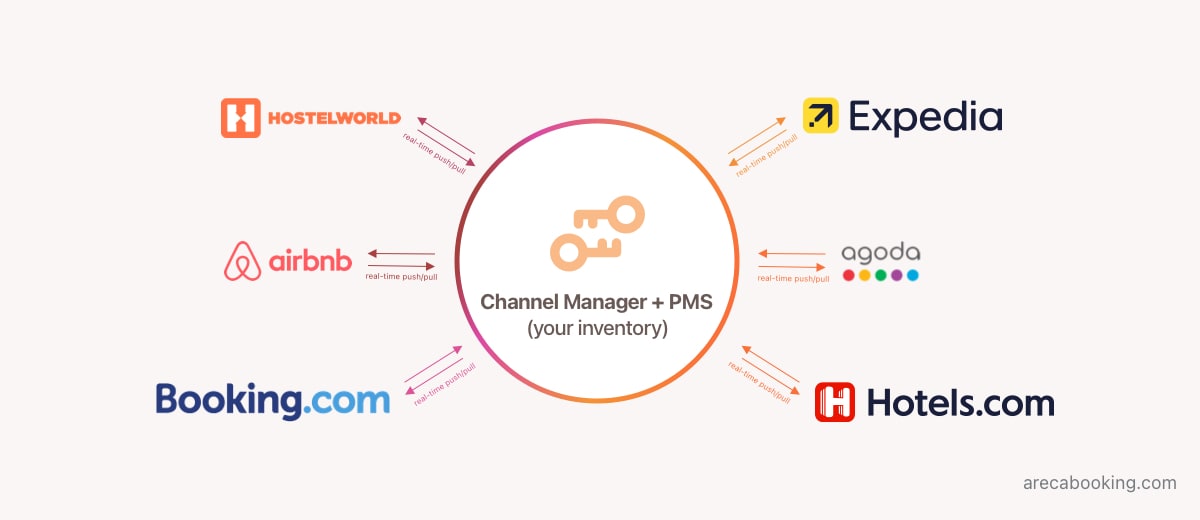
Every solid channel management setup is built around one concept: a single source of truth for your inventory. This is typically your PMS, though in simpler setups it may be the CM itself.
The idea is straightforward. Rather than each OTA holding its own version of your availability, there is one authoritative record of what is available, at what price, under what conditions. That record lives in your system. The CM reads from it and pushes the current state outward to every connected channel simultaneously.
When a booking arrives anywhere, it writes back to that central record first. The CM then pushes the updated availability to every other channel. Every platform is always reading from the same pool. There is no "Booking.com version" and "Airbnb version" of your calendar. There is one calendar.
This architecture is what makes everything else possible. Without a single source of truth, you are always playing catch-up.
Real-time two-way sync
"Sync" as a word is used loosely in this industry. It is worth being precise about what it means in practice.
A true two-way real-time sync means:
- When your PMS or CM updates a rate or closes availability, that change is pushed outward to all connected OTAs within seconds.
- When a booking arrives on any connected OTA, it is pulled into your system immediately and availability is updated across all other channels before the next booking attempt can succeed. The "two-way" part matters as much as the "real-time" part. A one-way sync that only pushes your changes outward without reliably pulling bookings in will still produce overbookings. Both directions need to be fast, reliable, and automatic.
With a properly configured API connection, the round trip from "booking received" to "all other channels updated" completes in under 30 seconds. This speed matters more than ever in 2026, because guests increasingly book on mobile apps while making real-time decisions. A traveller browsing Airbnb at an airport, seeing a room available and booking it instantly, has zero patience for a sync that needs 15 minutes to catch up. That 15-minute window is precisely where your overbooking happens.
Pooled inventory
One specific mechanic worth understanding before you set up your first CM is pooled inventory, because the alternative approach (allocated inventory) is a common and costly mistake.
-
Allocated inventory means you assign a fixed number of rooms to each OTA: 3 rooms to Booking.com, 3 to Airbnb, 2 to Expedia, 2 held for direct bookings. The problem is that if Booking.com's allocation fills up but Expedia still has unsold rooms, you have created artificial scarcity. You turn away guests who are ready to book while inventory sits idle elsewhere.
-
Pooled inventory means all 10 rooms are available on every channel simultaneously. The pool is shared. When a room is sold anywhere, the count decreases for everyone. When a booking is cancelled anywhere, the count increases for everyone. You only stop selling when you truly have nothing left to sell.
Pooled inventory consistently produces higher occupancy and less manual work. It is the only rational approach for properties with a small to medium room count. Your CM should support it natively.
This backend pooling does not dictate how your direct website presents rooms to guests. You can keep pooled inventory in the PMS/channel manager and still choose the guest-facing model that converts better for your property. This room display guide breaks that decision down.
The three pillars of channel management
The reason to invest in channel management can be organised around three goals. Each is distinct, but they reinforce each other.
Pillar 1: Reaching more guests
The most visible benefit of listing on multiple OTAs is access to their combined audiences. Booking.com alone processes over 1.5 million room nights per day globally. Expedia Group's portfolio of brands (Expedia, Hotels.com, Travelocity, Orbitz, Vrbo) reaches hundreds of millions of travellers. Airbnb has built an audience that skews toward experience-seeking guests who may not check traditional hotel OTAs at all. Each platform is a different funnel with different traveller demographics.
But there is a less obvious benefit that is well-documented in hospitality research: the Billboard Effect.
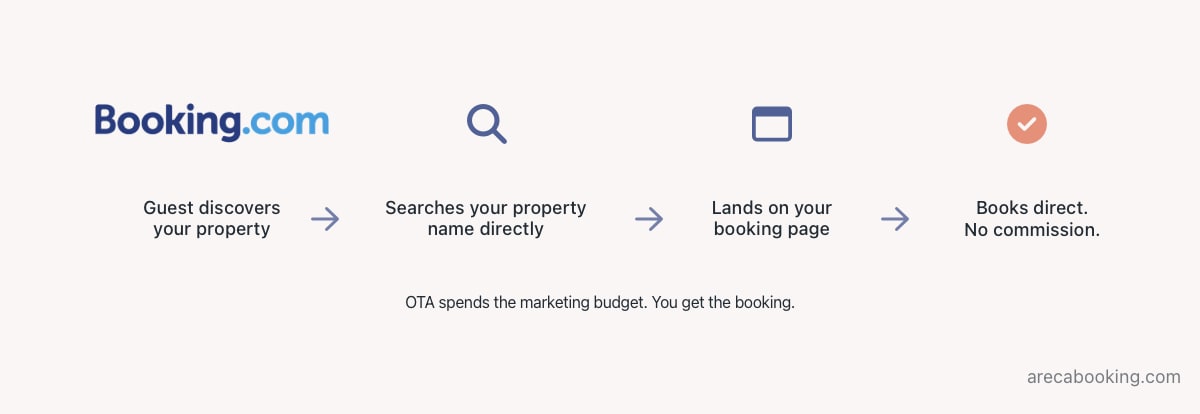
"Properties listed on Expedia saw a 7.5% to 26% increase in direct bookings as a direct result of OTA visibility alone, with smaller independent properties benefiting more than larger chains."
When a traveller sees your property on Booking.com or Expedia, a meaningful percentage of them will then search directly for your property name before booking. The OTA listing acts as advertising even for guests who ultimately book direct. This means OTA distribution is not just about the commission-bearing bookings you receive through the platform. It is also quietly subsidising your direct channel awareness.
Pillar 2: Managing inventory intelligently
As discussed above, pooled inventory is the foundation. But intelligent inventory management through a CM goes further than just keeping the pool shared.
A CM lets you set availability rules that fire automatically. Close all OTA channels when you hit a minimum number of available rooms, so you can hold those rooms for direct bookings or walk-ins. Open last-minute availability across all channels simultaneously when a cancellation comes in. Apply minimum-stay restrictions during high-demand periods across every platform at once.
Without a CM, each of these adjustments requires logging into every extranet and making the change manually. With a CM, they can be rule-based and automated. The result is inventory that responds dynamically to demand without requiring a human to monitor every channel throughout the day.
In 2026, this layer is increasingly powered by AI. Modern channel managers feed live availability and rate data into Revenue Management Systems (RMS) that use machine learning to adjust pricing dynamically based on demand signals, competitor rates, local events, and historical booking pace. You do not need to understand the algorithm to benefit from it. You need a CM that integrates with one.
Pillar 3: Preventing overbookings
The automated closure that a real-time CM enables is the single most operationally important function for a multi-channel property. The moment the last available room for a given night is sold on any channel, the CM fires closures to every other connected platform. That closure propagates in seconds.
This is the difference between a confidence-inspiring operation and one that keeps its host up at night. With iCal-based sync, the closure window can be 15 minutes to several hours. With API sync, that window collapses to seconds.
The business cost of an overbooking or double booking extends well beyond the immediate expense of walking a guest. A single 1-star review citing an overbooking is visible on your listing indefinitely. On Booking.com and Airbnb particularly, algorithmic ranking factors take cancellation rate and complaint rate into account. One avoidable overbooking can suppress your visibility for weeks.
iCal vs. API: The connection that changes everything
How your CM connects to an OTA matters as much as the fact that it connects at all. There are two fundamentally different technologies in use, and they produce significantly different operational outcomes.
| Feature | iCal (Calendar sync) | API (Direct connection) |
|---|---|---|
| Speed | Delayed (15+ minutes) | Real-time (seconds) |
| Reliability | High overbooking risk | Extremely secure |
| Data sent | Availability only | Rates, availability, restrictions, content |
| Direction | Pull (OTA asks your system) | Push (your system tells the OTA) |
| Setup | Free, no approval needed | Requires OTA certification |
| Best for | Part-time hobbyist hosts | Professional hotels and hostels |
iCal: pull technology (delayed)
iCal is a calendar file format originally designed for personal scheduling apps. When used for OTA sync, it works like this: you publish a calendar URL from your system, and the OTA periodically visits that URL to check for updates. "Periodically" means every 15 minutes in the best cases and every several hours in others.
This is a pull model. The OTA reaches out and asks for your current state. The problem is the gap between asks. During that gap, your calendar on the OTA may be showing outdated availability. A booking can land on Platform B while Platform A has already sold the room, but Platform B has not checked your calendar yet.
iCal is appropriate for very low-volume operations or single-channel properties using a second platform only as a safety net. At any meaningful booking volume across multiple channels, it is a liability.
API: push technology (instant)
An API (Application Programming Interface) connection is a direct, certified integration between your CM and the OTA's reservation system. When something changes in your system, your CM pushes that change to the OTA immediately. When a booking arrives on the OTA, it pushes a notification to your CM immediately. No polling, no waiting, no gap.
This is the standard for any serious multi-channel operation. Most major OTAs (Booking.com, Expedia, Airbnb) have formal connectivity certification programmes. Your CM needs to hold that certification to establish an API connection. Certified channel managers list their connected OTAs publicly, and it is one of the first things to check when evaluating a CM.
The practical framing: iCal is what a hobbyist uses to keep two calendars loosely in sync. API is what a business uses to operate reliably at scale. If you are managing more than two channels and doing meaningful booking volume, the question is not if you should move to API connections but when.
For a full breakdown of the technical differences and the revenue implications of staying on iCal too long, see: iCal vs. API connections: Why simple calendar syncing is killing your revenue.
Your 2026 distribution strategy
Knowing that you need a CM is the easy part. Knowing which OTAs to connect, in what order, with what rate strategy, is where the real work begins. For a detailed breakdown of every major platform, see our complete list of OTAs in 2026.
Start with the heavy hitters
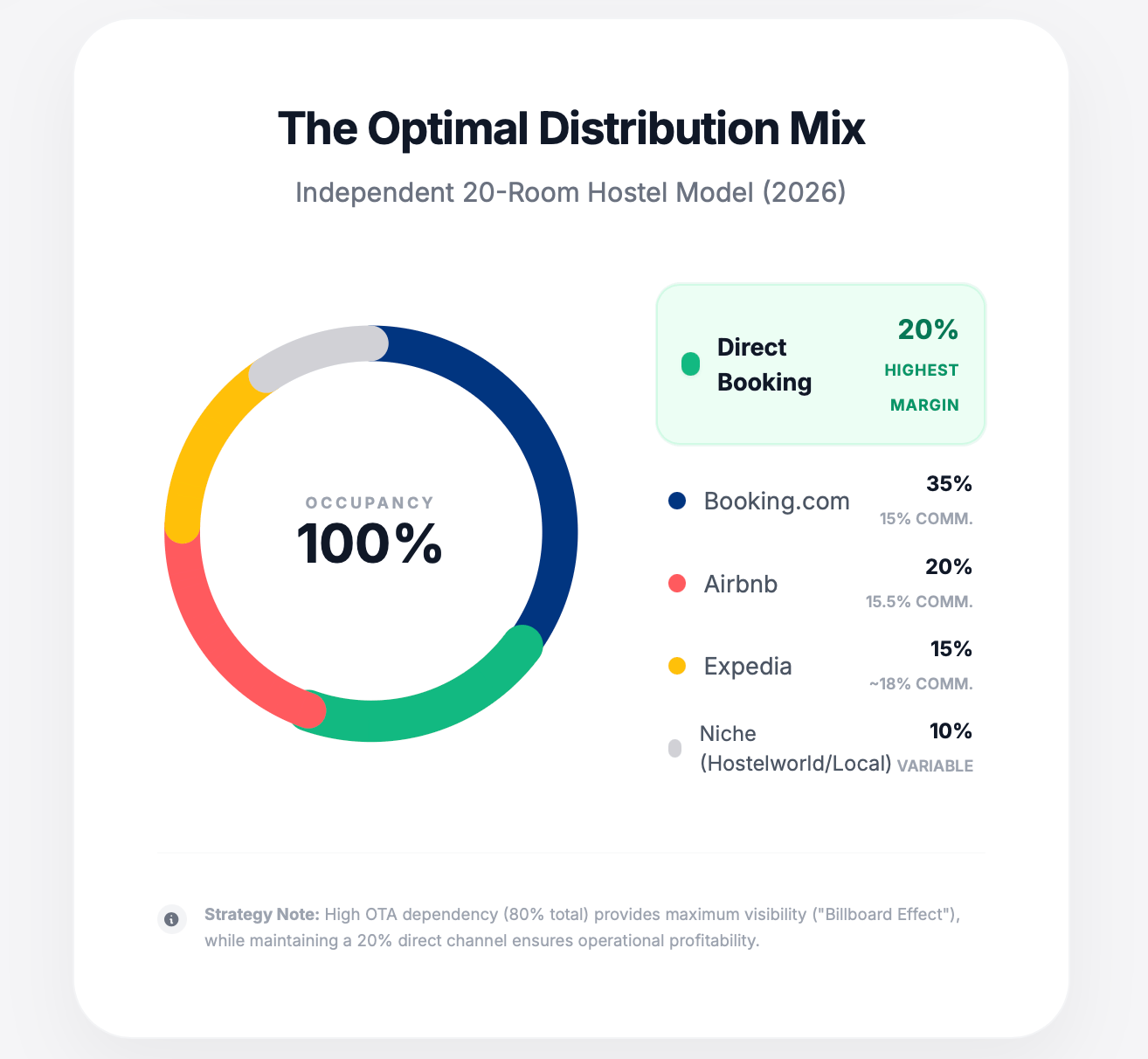
The three platforms that deserve a place in almost every independent property's distribution mix are Booking.com, Expedia, and Airbnb. Together they account for the majority of global online accommodation bookings and represent three meaningfully different traveller audiences.
-
Booking.com is the dominant platform in Europe and has strong global reach. Its commission typically sits at 15-18%, rising if you participate in Preferred Partner programmes or sponsored placements. It rewards properties with high review scores, flexible cancellation policies, and competitive pricing with algorithmically boosted visibility.
-
Expedia Group covers multiple booking brands simultaneously through one listing (Expedia, Hotels.com, Travelocity, Orbitz). Commission rates typically run 15-25% depending on the brand and your agreement. The group skews toward North American travellers and business-travel segments.
-
Airbnb completed its standardisation of the host-only fee structure in late 2025, settling at a 15.5% commission that now applies to all hosts including those using PMS and channel manager software (Hospitality Net / Lighthouse, 2025). Airbnb's audience is experience-focused, often younger, and more likely to book longer stays. For hostels and unique properties in particular, Airbnb visibility reaches guests who would not naturally start their search on Booking.com.
The niche factor: the secret sauce for 2026
The Big Three give you reach. Niche and regional OTAs give you qualified reach, meaning guests who are specifically looking for what you offer.
Hostelworld is the obvious example for budget accommodation: travellers on that platform are actively filtering for hostel-style stays, so your conversion rate on a well-optimised listing is higher than on a general platform where your property competes against every hotel in the city. Commission sits between 10-25%, with the notable model difference that the commission is added to the guest's booking price rather than deducted from your payout.
Beyond the established players, regional OTAs in high-growth markets deserve attention in 2026. Platforms targeting Southeast Asian travellers, Latin American markets, or specific interest segments (cycling tourism, sustainable travel, long-stay digital nomads) often carry lower commissions than the major OTAs and attract guests with strong intent alignment.
Rate parity: keeping prices consistent across channels
Rate parity means charging the same room rate across all OTA channels. Most OTA contracts include rate parity clauses requiring it, and violations carry real penalties: listing demotion, removal from preferred programmes, or in some cases, contractual consequences.
The practical discipline is straightforward: update all your rates through your CM, not by logging into individual extranets. When every rate change originates in one place and propagates outward automatically, parity is a structural outcome rather than something you have to actively monitor.
The more nuanced question is if your direct booking channel should be priced differently. Strict rate parity clauses have faced legal challenges in several European markets, and a number of jurisdictions have ruled against the most restrictive forms of them. The strategic opportunity is to offer direct bookers something the OTAs cannot: a package, a loyalty discount, a room upgrade, or an early check-in. Matching the room rate while adding exclusive direct perks is often a more effective direct booking driver than a headline price discount that puts you at risk of OTA penalties.
The commission reality
It is worth grounding the OTA selection conversation in the actual margin numbers. According to Kalibri Labs data cited by Hotel Tech Report, OTA commissions have risen 45% as a share of guest-paid revenue since 2015. What used to sit around 10% is now firmly in the 15-30% range across major platforms.
On a 100 EUR room night at 20% commission, you receive 80 EUR. On a direct booking through your own Booking Engine with a 2% payment processing fee, you receive 98 EUR. The 18 EUR difference per booking, multiplied across hundreds of bookings per year, is a compelling argument for actively building your direct channel alongside your OTA presence, not instead of it.
Direct bookings also carry a significantly lower cancellation rate: approximately 12%, versus considerably higher rates on OTA bookings where flexible cancellation policies and easy rebooking make cancellations easy for guests. This means that the effective commission on OTA bookings is even higher when you factor in the cost of cancellations and rebookings.
Implementation checklist for beginners
If you are setting up your first channel manager or migrating from manual management to an automated setup, this is your Day 1 roadmap.
Step 1: Audit your current channels
List every platform you are currently listed on. For each one, note: the connection type (API or iCal sync), your current commission rate, the volume of bookings it delivered in the last 90 days, and your cancellation rate from that channel. This audit gives you a baseline and helps you prioritise which channels to connect first.
Step 2: Clean up your listings
Before you connect a CM, ensure your photos, descriptions, amenity lists, room configurations, and house rules are consistent across every platform. A CM will sync your availability and rates, but it will not fix inconsistent content. Guests who find you on Booking.com and then check Airbnb should see the same property presented in the same way. Inconsistency erodes trust and reduces conversion.
Step 3: Choose a CM with certified API connections
When evaluating channel managers, the primary technical requirement is certified two-way API connectivity to the OTAs you intend to use. Ask each vendor specifically: which of your OTA connections are API-based, and which are iCal? Get this in writing. A CM that advertises "500 OTA connections" but connects most of them via iCal is a meaningfully different product from one with certified API connections to the 10 OTAs that matter to your property.
Other factors to evaluate: does it integrate with your PMS or include PMS functionality? Does it support pooled inventory? What is the support response time when a sync issue occurs outside business hours? Does it include a unified reservation inbox?
Popular options in the independent property segment include Cloudbeds, Beds24, Little Hotelier or Areca. If you are building a custom or semi-custom PMS, confirm that the CM offers a well-documented API for PMS integration.
Step 4: Map your room types
Before going live, configure your room types in the CM to match exactly how they appear on each OTA. Mismatched room type mapping is one of the most common sources of inventory sync errors. A "Dormitory Bed" in your PMS needs to map correctly to the equivalent product on Hostelworld, Booking.com, and Airbnb, even though each platform labels and categorises shared accommodation differently.
Step 5: Test the sync before going live
Do not assume the connection is working. After setup, perform a test booking on one channel and verify that the availability update fires to all other connected channels within 30 seconds. Most CM dashboards include a sync log where you can see update events in real time. If you cannot see the update propagate, do not go live until the issue is resolved.
Run this test again after any significant configuration change, and any time you add a new OTA connection.
Step 6: Monitor the first 30 days closely
The first month of live operation is when configuration gaps surface. Check your sync log daily. Compare your CM's reservation list against each OTA extranet to confirm bookings are landing correctly in both places. Flag any discrepancy immediately with your CM's support team.
After 30 days of clean operation, you can move to a lighter monitoring cadence. But the first month is worth close attention.
Looking ahead: Beyond basic syncing
Getting your core OTA channels connected via real-time API sync is the foundation. For more advanced properties, there are several additional strategies to layer on top of that foundation to further optimise your distribution and revenue.
Metasearch
Platforms like Google Hotels, Trivago, and Kayak sit between OTAs and direct booking. They aggregate rates from multiple sources and let travellers compare before clicking through to book. Being present on metasearch, and ideally having your direct booking rate visible alongside OTA rates, is one of the most effective ways to capture the guest who found you on an OTA but is willing to book direct if the price is right.
The distribution mix
A fully OTA-dependent business is a vulnerable business. Commission rates can rise, algorithms can change, a platform can exit a market. The most resilient properties in 2026 treat OTAs as one important channel within a broader distribution mix that includes a direct Booking Engine, loyalty or repeat-guest programmes, and potentially corporate or group booking channels.
AI-driven revenue management
The next evolution beyond a channel manager is connecting it to an AI-powered Revenue Management System. Modern RMS tools ingest your live availability data, historical booking pace, competitor rates, local event calendars, and demand signals to recommend or automatically apply pricing changes. The CM becomes the execution layer; the RMS becomes the brain. For a property serious about maximising RevPAR, this integration is where the meaningful gains now live.
The Global Distribution System
The GDS (Sabre, Amadeus, Galileo) is the distribution layer used by corporate travel managers and travel agents to book accommodation for business travellers. It is largely invisible to leisure guests but represents a significant revenue opportunity for properties in business travel destinations. Your need for GDS access depends heavily on your property type and location.
Rate and policy consistency
As your distribution footprint grows, keeping your rate plans and cancellation policies coherent across channels becomes its own discipline. Inconsistency creates OTA penalties, guest confusion, and revenue leakage.
Conclusion: The channel management imperative in 2026
Channel management in 2026 is not optional for any independent property taking multi-channel distribution seriously. The question is if yours is built on technology that holds up under real operating conditions.
Start with the foundation: a CM with certified API connections, pooled inventory, and integration with your PMS or Booking Engine. Get the Big Three connected with proper two-way sync. Audit your rate parity. Test before you go live.
Once that foundation is solid, every other strategy in this pillar, from niche OTAs to metasearch to GDS to the direct booking mix, has a reliable base to build on.