Booking engine vs. OTA: The ROI calculator for independent properties
You got a booking last night. Feels good, right?
Here is the part that stings a little: that booking was not €200 in revenue. It was €200 minus the commission, minus the payment processing, minus the time you spent answering the OTA's automated messages. For most independent properties, the "booking" is not revenue. It is revenue minus acquisition cost, and that gap is quietly eating your margin.
This post is a financial health check. No fluff, no "OTAs are evil" rant. Just a clear look at the math, so you can decide how aggressively you want to shift your distribution mix.
If you also want the operational side of that shift, this direct bookings guide walks through the full system behind sustainable direct growth.
The hidden tax on your hard work
When Booking.com or Expedia sends you a guest, they charge a commission. Depending on your property type, market, and tier, that sits somewhere between 15% and 25% of the booking value. On a €200 stay, that is €30 to €50 gone before you even check the guest in.
Think about what that number actually represents:
- It is not a fee for a service you chose, renewed, or negotiated.
- It compounds. A 20% commission on €50,000 of annual OTA revenue is €10,000 per year. That is a part-time salary, a full software stack subscription, or your entire annual marketing budget.
- It is invisible. It never shows up as a line-item expense in most property managers' mental accounting, because the OTA simply deducts it before the payout lands.
The goal of this post is not to convince you to leave OTAs entirely. They are useful, especially during low season, for filling last-minute gaps, and for getting discovered by travellers who have never heard of your property. But there is a major difference between using OTAs as a tool and being dependent on them as your primary channel.
The "aha" table: what a booking actually nets you
Let's make this concrete. Here is a standard 2-night stay at €100 per night, compared across two channels:
| Metric | OTA booking (20% commission) | Direct booking (via Areca) |
|---|---|---|
| Gross revenue | €200 | €200 |
| Commission fee | -€40 | €0 |
| Software fee | €0 | ~€0.28 |
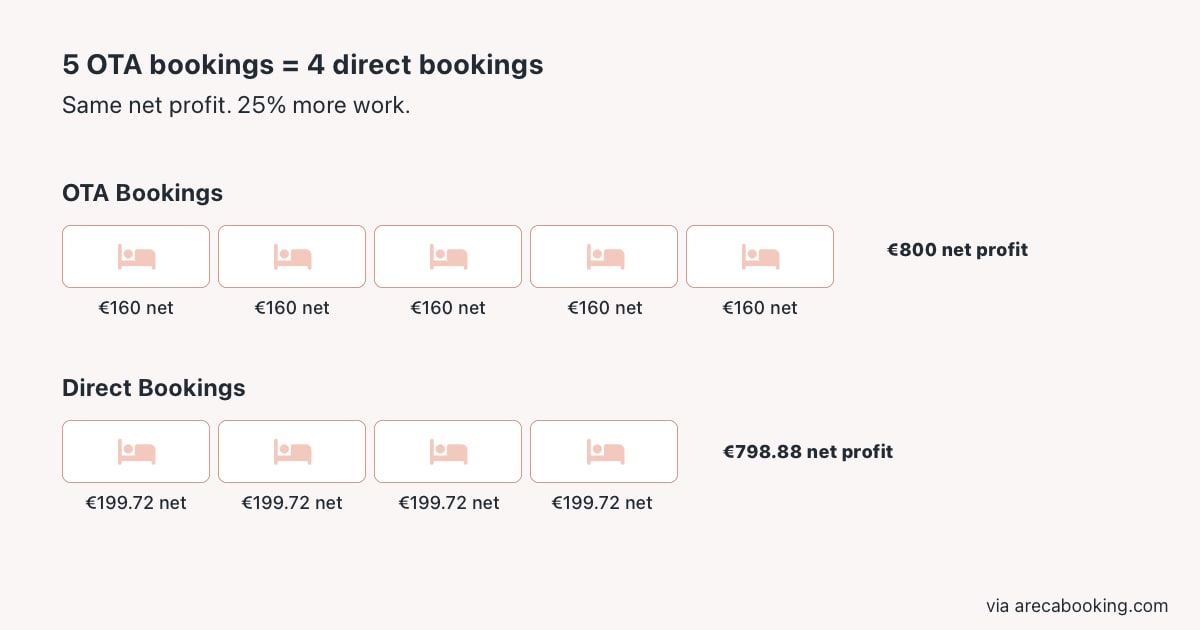
| Net profit | €160 | ~€199.72 |
| Margin | 80% | ~99.9% |
Areca costs €29/month for up to 10 rooms, all features included. At 70% occupancy, a 10-room property generates around 105 bookings per month, which works out to roughly €0.28 per booking. That is the full cost of your direct channel on a per-transaction basis.
The difference is nearly €40 on a single stay. That sounds modest until you run the annual math.
Here is the insight worth writing on a Post-it: to earn the same net profit as one direct booking, you need to sell roughly 25% more rooms on an OTA. That is not a statistic from a booking engine vendor's marketing deck. It is basic arithmetic. If your direct booking nets ~€200 and your OTA booking nets €160, you need 1.25 OTA bookings to match it.
The DIY ROI calculator
You do not need a fancy tool for this. Here is the formula:
Annual savings potential =
  (Total annual OTA revenue × Average OTA commission %)
  − (Total annual OTA revenue × Direct booking cost %)
  × % of volume you could realistically shift to direct
Let's run two real scenarios.
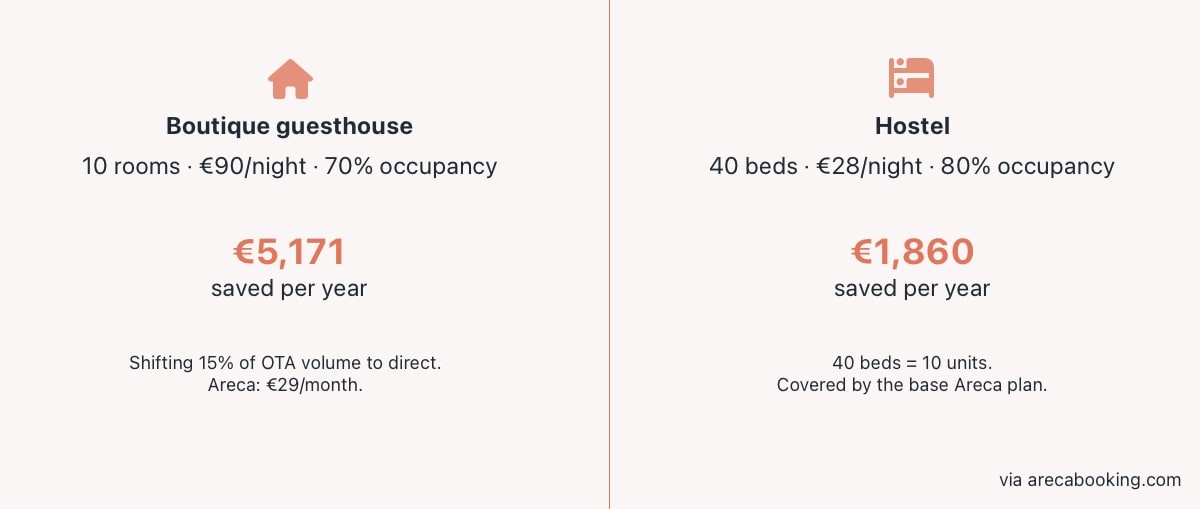
Scenario A: Small boutique guesthouse
- 10 rooms, average rate €90/night, 70% annual occupancy
- Current OTA mix: 80% of bookings come via OTA at 20% commission
- Realistic shift: moving 15% of volume to direct
The numbers:
- Annual room revenue: 10 × 365 × 0.70 × €90 = €229,950
- OTA revenue (80% of total): ~€183,960
- Commission paid annually: 20% of €183,960 = €36,792/year
- Revenue shifted to direct (15% of OTA volume): ~€27,594
- Commission saved: €27,594 × 20% = €5,519
- Areca annual cost (€29/month): -€348
- Net annual saving: ~€5,171
That is over €5,000 per year from a single, modest shift in channel mix, without adding a single new guest. And the €348 annual cost covers the entire booking engine, not just the direct bookings portion.
Scenario B: Mid-size hostel
- 40 beds, average rate €28/night, 80% occupancy
- Current OTA mix: 75% via OTA, average commission 18%
- Realistic shift: even just 5% of volume to direct
The numbers:
- Annual bed revenue: 40 × 365 × 0.80 × €28 = €327,040
- OTA revenue (75%): ~€245,280
- Commission paid annually: 18% of €245,280 = €44,150/year
- Revenue shifted to direct (5% of OTA volume): ~€12,264
- Commission saved: €12,264 × 18% = €2,208
- Areca annual cost (€29/month: 40 beds = 10 units, within the base plan): -€348
- Net annual saving: ~€1,860
Worth noting: Areca counts 4 shared dorm beds as 1 unit, so a 40-bed hostel only uses 10 of the 15 units included in the base €29/month plan. The entire booking engine costs less than a dinner out per month. Push the direct shift to 10% and the net saving climbs to over €4,000 per year.
Want to run your own numbers? We are building an interactive version of this calculator into Areca. Contact us and we will send you the free spreadsheet template to calculate your exact saving right now.
Beyond the cash: the invisible ROI
The ~€40 you save per booking is just the visible part. Here is what the commission line does not show you.
You own the guest relationship
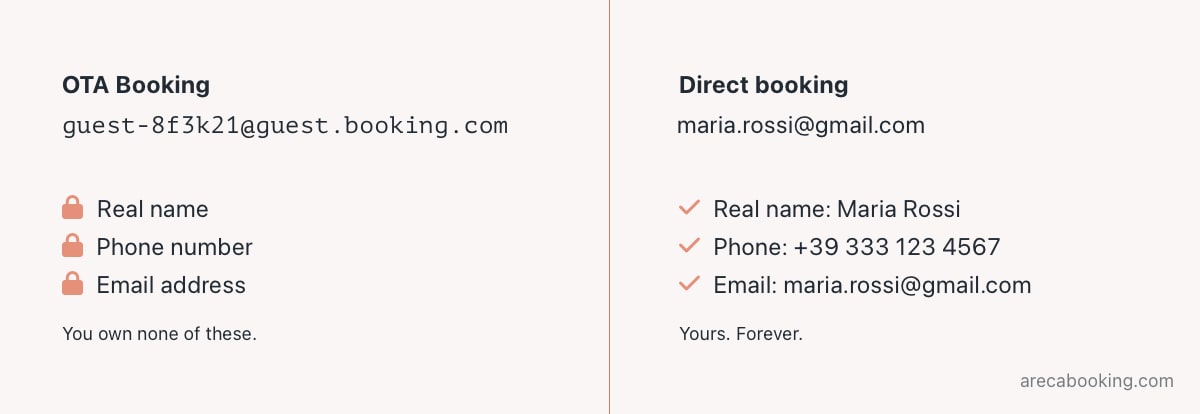
When a guest books through Booking.com, the email address in your reservation is something like [email protected]. It is masked. You cannot contact that guest before arrival without going through the OTA's messaging platform, and after checkout, they are gone. The OTA owns the relationship.
When someone books direct, you get their real email address. That means:
- A pre-arrival message with your upsell offers (early check-in, breakfast, airport shuttle), all 100% commission-free revenue.
- A post-stay follow-up requesting a Google review.
- An email for next year's special offer season.
Over time, this data compounds. Your direct booking channel is not just cheaper per transaction. It builds an asset the OTA cannot take away from you.
Direct guests cancel less
This is a pattern that shows up consistently across hospitality data: guests who book direct tend to have lower cancellation rates than OTA bookers. The reasons are straightforward. OTA travellers are often "window shoppers" who place multiple reservations and cancel the ones they no longer need. Direct bookers have made a more deliberate decision.
If your current cancellation rate via OTAs is sitting around 25-35% (common for many European properties), even a modest shift to direct can improve occupancy predictability significantly.
Pre-arrival upsell revenue is entirely yours
A guest who books via Booking.com and then buys a €15 breakfast upsell from you? That upsell is yours. But you only discovered they wanted breakfast because Areca (or any direct booking system) let you ask at checkout. An OTA booking flow has no mechanism for this, and even if you add the upsell manually later, the OTA does not share in that revenue. The point is: direct bookings create the conditions for upsells. OTA bookings mostly do not.
The billboard effect: use OTAs, don't work for them
Here is a strategy that experienced property managers use without always naming it.
Booking.com and Expedia have enormous marketing budgets. They spend millions on Google Ads, SEO, TV campaigns, and loyalty programmes, all to bring travellers to their platforms. When a guest finds your property on Booking.com for the first time, the OTA did real work to make that happen. That discovery has value.
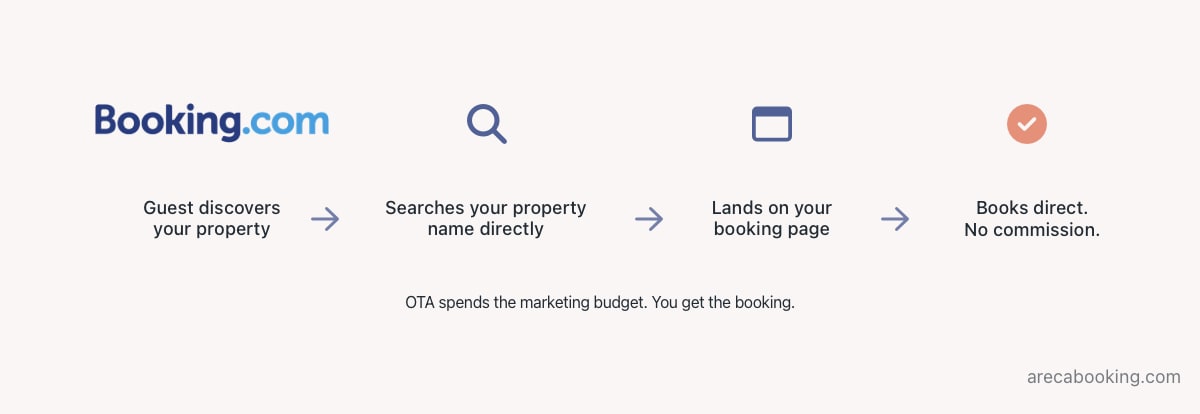
The billboard effect is what happens next. A guest sees your property on an OTA, but before booking, they search for your property directly, on Google, on your website, or by typing your name into the search bar. Research has consistently shown that OTA listings drive traffic to independent hotel websites, where a portion of visitors convert to direct bookings.
The implication is not "abandon OTAs." It is: make sure your direct booking option is better than your OTA listing when that comparison happens.
That means:
- Your website loads fast and is mobile-friendly.
- Your direct rate is at least as good as your OTA rate (or slightly better, with a small perk).
- Your booking flow is simple. If it takes more than 3 clicks to confirm a booking, you are losing guests back to the OTA.
OTAs are a discovery channel. Your website is the conversion channel. Both have a role, but the economics only work in your favour if direct bookings are actually possible and easy.
What "autopilot" actually looks like
The goal of Areca is to make this financial shift happen without adding work to your day. You should not need to manually run ROI calculations, chase guests for direct contact details, or remember to send pre-arrival upsell messages.
The idea is that a well-configured booking engine handles the maths automatically: it captures real guest data, sends the right messages at the right times, and surfaces clear numbers on what your direct channel is actually earning you. Not what a guest paid in gross, but what you actually keep.
That is the version of property management we are building toward.
A note on balance
If you manage a 12-room guesthouse in a secondary city and you are currently at 40% occupancy, OTAs are not your enemy. They are probably your most cost-effective way to fill beds right now, and that is fine. The goal of this post is not to demonise the channel. It is to help you see the cost clearly, so you can make the decision with full information.
The properties that get hurt are the ones that grow dependent on OTAs, stop investing in their own website, and find themselves 90% reliant on third-party channels with no guest data and no direct relationship. That is the pattern worth avoiding.
Get the free ROI spreadsheet
We are building Areca to make this maths the default for every property we work with. Clear numbers, direct profit, no manual calculations required.
We have also built a free ROI spreadsheet template that lets you run your own scenario in about 5 minutes. Enter your room count, average rate, current OTA mix, and commission rate, and it calculates exactly how much you could save per year at various direct booking targets.
Email us and we will send it to you. No catch, no sales call required. Ready to put direct bookings to work? Sign up for Areca.