iCal vs. API connections: Why simple calendar syncing is killing your revenue
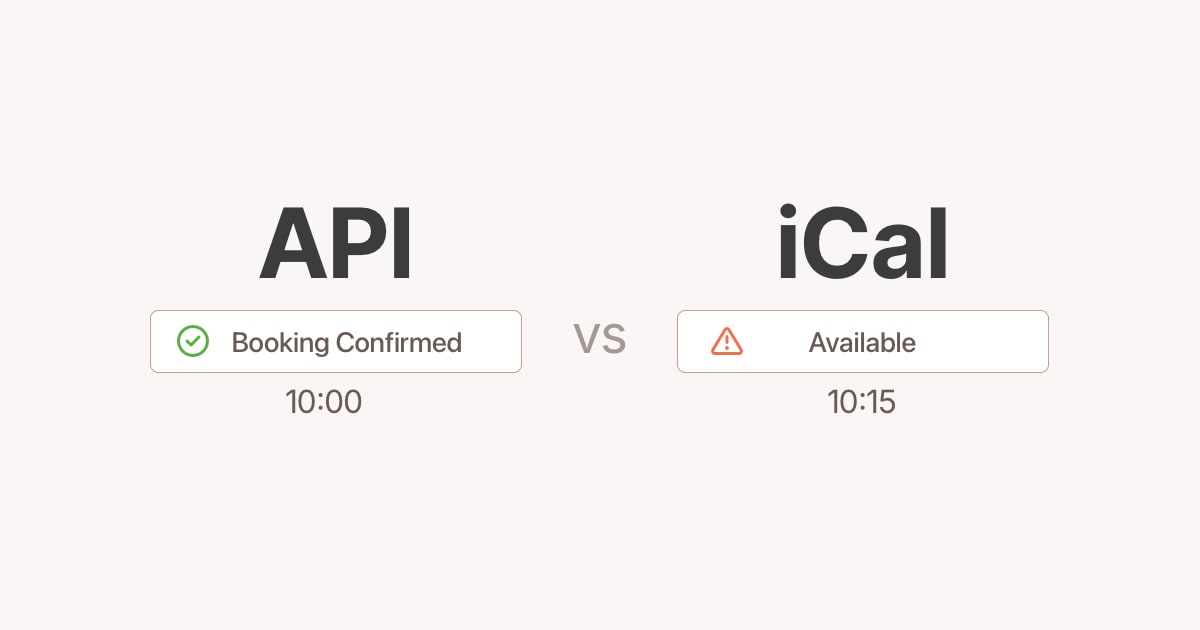
There's a conversation we have with property owners all the time. It usually starts with something like: "We had a double booking last weekend and I have no idea how it happened."
When we dig in, the answer is almost always the same: they were relying on iCal to keep their calendars in sync across channels.
It's not their fault. iCal is free, easy to set up, and most booking tools offer it as a connection method. It looks like it's doing its job. The problem is what happens in the gap between when a booking lands and when that calendar actually updates. If you're still getting familiar with how channel managers fit into the bigger picture, our beginner's guide to OTA channel management covers the fundamentals. This post goes deeper on one specific decision that has an outsized impact on your operations.
What iCal actually is (and isn't)
iCal (or .ics) is a file format, not a real-time communication protocol. Think of it as a snapshot of your calendar that gets exported to a URL. Other platforms periodically fetch that URL and update their own calendar based on what they find.
The keyword there is periodically.
Most platforms poll iCal feeds every 15 minutes to 24 hours. Booking.com, for example, refreshes iCal imports every two hours. Airbnb is faster, but still not instant.
So here's what can happen in a completely normal scenario:
- A guest books your last available room on Booking.com at 10:00.
- Booking.com marks it as taken in its own system immediately.
- Your iCal feed for Airbnb hasn't refreshed yet.
- A second guest books the same room on Airbnb at 10:20.
- Both guests have confirmation emails. You have a problem.
This is the overbooking nightmare, and it's not a glitch. It's a design limitation baked into how iCal works.
The latency problem is only part of it
Even if you could tolerate a 30-minute sync window (most properties can't during high season), iCal has a deeper structural limitation: it only syncs availability.
That's it. Just blocked/unblocked dates.
A real-time API connection, by contrast, sends and receives a full package of information in milliseconds:
| What gets synced | iCal | API |
|---|---|---|
| Availability (blocked dates) | Yes, with delay | Yes, instantly |
| Rates | No | Yes |
| Minimum stays | No | Yes |
| Room/bed type specifics | No | Yes |
| Cancellations | With delay | Instantly |
| Booking modifications | No | Yes |
| Number of guests | No | Yes |
This means that even if you never get a double booking, you may still be losing money quietly. If you update your rates on a Tuesday for a busy summer weekend and some of your channels are still showing last week's iCal-imported data, guests are booking at outdated prices. You won't see it until the reservation lands.
Why this hits small properties hardest
Large hotel chains have dedicated revenue managers who catch pricing discrepancies. They also often maintain rate parity contractually across all channels, which limits the damage.
Small properties, guesthouses, and hostels don't have that buffer. If you're running a 12-bed hostel and you have a double booking on a Friday night, you're not just dealing with an awkward phone call. You're potentially:
- Manually relocating a guest at your own cost
- Losing a review
- Getting flagged by the OTA for reliability issues (which affects your ranking)
- Spending your evening managing a crisis instead of running your property
The math is brutal. One double booking a month costs more than most good channel managers charge in a year.
When iCal is (and isn't) acceptable
We want to be honest about this, because iCal does have a place in the ecosystem.
iCal is fine for:
- Low-volume platforms you treat as secondary channels (niche sites, local tourism portals)
- Platforms that don't yet support API integration
- Personal blocking of dates for maintenance or owner stays, where you control both sides
- Properties with very low channel overlap and long lead-time bookings (multi-month villa rentals, for example)
iCal is dangerous for:
- Any channel that receives more than a handful of bookings per month
- High-season periods where rooms turn quickly
- Hostels managing individual bed inventory (the granularity iCal needs simply doesn't exist)
- Properties listed on more than two active OTAs simultaneously
The risk scales directly with how many channels you're active on and how quickly your rooms sell. The more channels, the shorter your booking window, the more damage iCal latency can do.
What an API connection actually looks like
When Areca connects to a channel via API, here's what happens when a booking comes in:
- The OTA sends a booking notification directly to Areca's server via API, in real time.
- Areca instantly marks that inventory as unavailable in its own system.
- Areca pushes the updated availability to every other connected channel simultaneously, also in real time.
There's no polling. No waiting. No window of vulnerability.
The same process happens in reverse when you update rates or minimum stays: Areca pushes those changes to every API-connected channel immediately. What was a 24-hour delay becomes a 2-second update.
For bed-level inventory in hostels, this matters even more. iCal has no concept of individual beds within a dorm room. An API connection to a platform like Hostelworld can communicate that there are 3 beds available from the 6 bed dorm, while iCal would simply block the entire room, or worse, provide no meaningful signal at all.
"But my current tool uses iCal and I've never had a problem"
This is probably the most common thing we hear, and it's worth taking seriously.
A few possibilities:
-
You've been lucky.
The risk is probabilistic. Properties with fewer active channels and lower booking volumes can run iCal for years without a collision. But as you grow, the probability compounds. -
You've had near-misses you didn't notice.
A booking that came in one minute after your iCal refreshed looks identical to a booking that came in safely. You only notice the problem when two bookings arrive in the same gap. -
Your channels naturally don't overlap much.
If your Airbnb guests tend to book months ahead and your walk-ins handle same-week availability, your risk profile is lower.
The moment you run a promotion, list on a new channel, or hit a high-demand event weekend, that risk calculus changes.
How Areca approaches this
Areca is built API-first. That means we prioritise direct API integrations with major OTAs and booking platforms wherever they exist, because we believe that real-time inventory management isn't a premium feature; it's the baseline for running a property professionally.
That said, we do support iCal for smaller or niche channels where a full API partnership doesn't exist yet. We treat it as a fallback, not a foundation. If you're managing a property that lists on a platform without API access, Areca will use iCal for that connection while keeping your primary channels on real-time API. We also give you visibility into which connections are iCal-based so you can manage the associated risk consciously.
If you're evaluating a channel manager and the tool you're looking at relies primarily on iCal for major OTAs like Booking.com, Expedia, or Airbnb, that's a significant red flag. All three of those platforms offer full API connectivity to certified channel managers.
Conclusion
iCal was designed for sharing personal calendars between apps. It was never intended to power real-time inventory management for a commercial property. Using it as your primary synchronisation method across OTAs is a bit like using a shared Google Calendar to run your booking operations: it works until it doesn't, and when it fails, it fails in the worst possible way.
The double booking nightmare is preventable. The fix isn't complicated or expensive. It's just choosing the right technical foundation.
If you're not sure if your current setup is API or iCal-based for each of your channels, it's worth finding out before your next busy weekend.