List of OTAs in 2026: 30+ booking channels compared
Not all online travel agencies are created equal. Booking.com dominates Europe. Trip.com is the gateway to Chinese travellers. MakeMyTrip owns India. Hostelworld is a must if you run a hostel. And somewhere in that mix sits the exact combination that fits your property, your target guests, and your margin.
This guide covers every major OTA operating in 2026 (global, regional, and niche) with commission rates, connection types, popularity by region, and a clear way to decide which ones are worth connecting to. If you only want to know which OTAs are the biggest, jump to the largest OTAs in the world.
New to channel management? Start with our beginner's guide to OTA channel management for a full walkthrough of how channel managers work and why real-time syncing matters.
What is an OTA and why does the channel mix matter?
An OTA (online travel agency) is a platform that lets travellers search, compare, and book accommodation online. When a guest books through one, you pay a commission, typically between 10% and 30% of the booking value, in exchange for the platform's marketing reach, payment processing, and customer service.
The OTA market is large and growing. Global online bookings are projected to make up 65% of all travel bookings worldwide by 2026, with OTAs holding a commanding share of that traffic. The challenge for any property is not just being visible: it is being visible to the right travellers, at the lowest possible cost per booking.
That is where a smart channel mix comes in. Most properties benefit from listing on two to four OTAs, with direct bookings as the foundation. The right combination depends on your location, property type, target guest profile, and margin tolerance. Once you list on more than one OTA, keeping availability in sync between them is the job of a channel manager.
The largest OTAs in the world in 2026
Most of the online travel market belongs to four groups. Each one owns several brands, so a single listing often appears on more than one website. The figures below come from each company's full-year 2025 results, the latest complete year available: Booking Holdings, Airbnb, Expedia Group, and Trip.com Group.
| Group | Main brands | Room nights booked (2025) | Gross bookings (2025) | Revenue (2025) |
|---|---|---|---|---|
| Booking Holdings | Booking.com, Agoda, Priceline, Kayak | 1.24 billion | $186.1 billion | $26.9 billion |
| Airbnb | Airbnb | 533 million* | $91.3 billion | $12.2 billion |
| Expedia Group | Expedia, Hotels.com, Vrbo, Wotif, Hotwire | 415 million | $119.6 billion | $14.7 billion |
| Trip.com Group | Trip.com, Ctrip, Qunar, Skyscanner | not reported | not reported | RMB 62.4 billion (about $8.9 billion) |
*Airbnb reports "nights and seats booked", which also counts experiences and services.
Booking.com is the biggest single OTA in the world. Booking Holdings books roughly three times as many room nights as Expedia Group, and most of that volume comes through Booking.com.
Airbnb is the largest platform for vacation rentals, with over 9 million active listings at the end of 2025. It is no longer only for private homes: boutique hotels, B&Bs, and aparthotels can list too.
Expedia Group is strongest in North America. One listing on Expedia also places your property on Hotels.com and other group brands.
Trip.com Group is the largest OTA in China and is growing fast outside it. Its accommodation revenue grew 21% in 2025.
Size is not the same as fit, though. A hostel will often get more bookings from Hostelworld than from Expedia, and a property in India will get more local guests from MakeMyTrip. The sections below cover each platform in detail.
Understanding connection types
Before diving into the channel list, it helps to understand how OTAs actually connect to your system. There are three types.
Full two-way API connection is the gold standard. When a guest books on Booking.com, your inventory updates on Expedia and every other connected channel within seconds. Rates, availability, restrictions, and booking data all flow in real time through a channel manager. This is the connection type you want for any high-volume channel.
XML connectivity is technically a type of API connection: most major OTAs, including Booking.com and Expedia, use XML-based protocols (some based on the OpenTravel Alliance specification). For practical purposes, XML and API connections behave similarly and both deliver real-time two-way sync.
iCal sync is a simpler, older method. Your availability calendar is exported as a URL that OTAs can periodically check: typically every few hours. It does not sync rates, and it is slow enough to carry a real risk of double bookings. Use iCal only for low-volume channels where a full API integration is not available, or as a stopgap while setting up a proper connection.
Check out comparison of iCal vs API connection types for a deeper dive into the pros and cons of each connection type.
Global OTAs: the essential channels
These platforms have worldwide reach and are relevant to almost every property type and location.
Booking.com

URL: booking.com
Parent company: Booking Holdings
Commission: 15-25% (average ~15-18%; varies by location, cancellation policy, and visibility programmes)
Connection type: Two-way API (XML/B.XML)
Strongest regions: Europe, Middle East, Southeast Asia, Taiwan, Vietnam
Best for: All property types: hotels, hostels, guesthouses, apartments
Booking.com is the single largest accommodation OTA in the world by room nights. It holds over 28 million listings across 220+ countries, and in many European markets it accounts for the majority of online bookings. It is also the dominant channel in Taiwan (used by 72% of online travellers) and Vietnam (61%).
Listing is free: you only pay commission on completed bookings. The platform also operates visibility tools like Preferred Partner status and Genius programme participation, which can lift your ranking but typically come at a higher commission.
For most properties in Europe, the Middle East, or Southeast Asia, Booking.com is a non-negotiable first channel.
Expedia

URL: expedia.com
Parent company: Expedia Group (also owns Hotels.com, Orbitz, Travelocity, Vrbo, Hotwire, Trivago, Wotif)
Commission: 15-30% (independent hotels typically 15-30%; large chains negotiate closer to 10-15%)
Connection type: Two-way API (XML)
Strongest regions: North America, UK, Australia
Best for: Hotels targeting North American and package-deal travellers
Expedia Group is the second-largest OTA conglomerate globally, with Expedia.com alone attracting over 600 million monthly visits. One key advantage: listing on Expedia automatically distributes your property across Hotels.com, Orbitz, and Travelocity, expanding your reach across the group's network.
Expedia is particularly strong for travellers booking flights and accommodation as a package: a segment that generally shows lower cancellation rates and higher average booking values.
Airbnb

URL: airbnb.com
Parent company: Airbnb, Inc.
Commission: 3% host-only fee (split-fee model: ~3% host + 14-16% guest service fee; host-only model: 14-16% host, guest pays no extra fee. Note: split fee not available for PMS/channel manager integrations)
Connection type: Two-way API
Strongest regions: Global, particularly strong in North America, Western Europe, and Australia
Best for: Boutique hotels, B&Bs, unique or independent properties, aparthotels
Originally a home-sharing platform, Airbnb now welcomes boutique hotels and small independent properties. With over 7.7 million active listings globally, it reaches a distinct traveller segment that often prefers local, experience-driven stays over branded hotel chains. If your property has strong individual character, Airbnb can be a powerful complement to traditional hotel OTAs.
Commission structures can be confusing. Hosts using a channel manager must use the host-only fee model, which means the full service fee comes out of your payout rather than being added to the guest price.
Hotels.com

URL: hotels.com
Parent company: Expedia Group
Commission: Included in Expedia listing (no separate signup needed)
Connection type: Via Expedia API
Strongest regions: Global, US-heavy
Best for: Any hotel already listed on Expedia
Hotels.com is notable for its loyalty programme: guests earn a free night after ten bookings, which drives repeat traffic. Since listing on Expedia automatically populates Hotels.com, there is no separate setup required. Treat it as a free extension of your Expedia presence.
Agoda

URL: agoda.com
Parent company: Booking Holdings
Commission: 18-25% (higher if participating in Preferred programmes)
Connection type: Two-way API
Strongest regions: Thailand, Malaysia, Singapore, Philippines, Indonesia, South Korea
Best for: Properties targeting Asian travellers, especially Southeast Asia
Agoda is headquartered in Singapore and is the number one OTA across Malaysia, Thailand, Singapore, and the Philippines. It is a subsidiary of Booking Holdings but operates independently from Booking.com and maintains separate listings and inventory: meaning you need to connect to both separately if you want full coverage in Asia.
Agoda also offers "Book Now, Pay Later" and other features that perform particularly well with younger Asian travellers.
Trip.com (Ctrip)

URL: trip.com
Parent company: Trip.com Group (also owns Qunar, Skyscanner)
Commission: Typically 15-20%
Connection type: Two-way API
Strongest regions: China, broader Asia-Pacific, growing globally
Best for: Properties in Asia or those seeking to attract Chinese outbound travellers
Trip.com Group is the largest OTA in China and one of the largest in the world by volume. With over 90 million active users and access to more than 1.7 million global accommodations, it is the essential platform for any property hoping to attract Chinese guests. The group's ownership of Skyscanner also gives it a significant metasearch presence globally.
If you are in a destination that sees significant Chinese visitor numbers (much of Europe, Japan, Southeast Asia, Australia), Trip.com is worth serious consideration.
Priceline

URL: priceline.com
Parent company: Booking Holdings
Commission: Similar to Booking.com (15-25%)
Connection type: Two-way API
Strongest regions: United States
Best for: US-focused properties looking to move unsold inventory discreetly
Priceline's "Express Deal" feature lets hotels offer discounted rates without revealing the property name until after booking, which is useful for filling last-minute availability without undermining rate parity across your public channels. Primarily a North American platform.
Vrbo

URL: vrbo.com
Parent company: Expedia Group
Commission: 5% base + 3% payment processing (= 8% per booking); annual subscription option at $699/year
Connection type: Two-way API (since 2023; was iCal previously)
Strongest regions: United States, UK, France, Germany, Australia
Best for: Apartments, villas, vacation rentals, serviced apartments, properties with multiple-room inventory
Vrbo (Vacation Rentals By Owner) caters specifically to travellers looking for whole-property rentals and extended stays. With over 2 million listings, it is the leading vacation rental channel behind Airbnb. Properties suitable for families or groups (villas, holiday cottages, large apartments) often perform strongly here. Vrbo-listed properties also appear on Expedia, adding further reach.
Hostelworld

URL: hostelworld.com
Parent company: Hostelworld Group
Commission: 10-25% (unusually, commission is added to the guest's booking price, not deducted from your payout)
Connection type: Two-way API
Strongest regions: Global; particularly strong in Western Europe, Southeast Asia
Best for: Hostels, budget accommodation, social travel properties
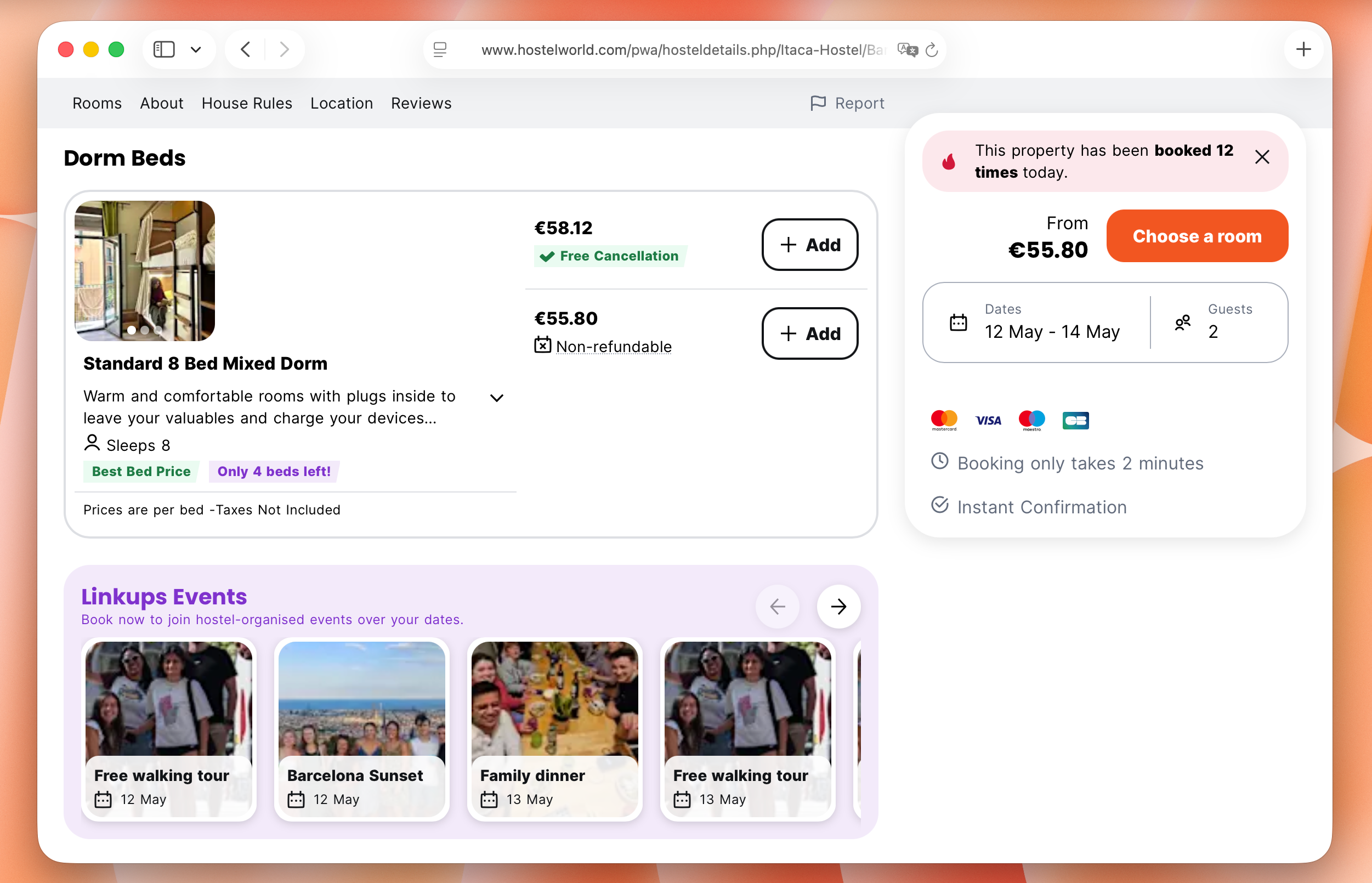
Hostelworld is the world's leading OTA for hostel bookings, operating in over 180 countries and covering the backpacker and budget travel market. The platform is built around social travel, connecting travellers with each other as much as with properties, which makes it particularly effective for independent hostels with a community feel.
One notable quirk: Hostelworld adds its commission to the guest's booking price rather than deducting it from the property's payout, which means you receive the full room rate and the OTA's margin is covered separately.
Hostelworld works best next to your own direct channel. If you sell dorm beds, see how a booking engine helps hostels cut OTA commissions for the bed-level features worth looking for.
Regional OTAs: reach the travellers global platforms miss
Regional OTAs often deliver higher-quality bookings for specific markets: guests who booked through a familiar local platform, using a local payment method, in their own language. Commission rates can also be lower than the global giants.
Asia-Pacific
 Rakuten Travel
URL: travel.rakuten.co.jp
Region: Japan (also strong for Japanese outbound travel)
Commission: ~10-15%
Connection: API
Rakuten Travel is Japan's leading domestic OTA, deeply embedded in the Rakuten ecosystem: Japan's largest e-commerce loyalty network. For properties in Japan or destinations popular with Japanese tourists, it is an essential listing.
 MakeMyTrip / Goibibo
URL: makemytrip.com / goibibo.com
Region: India
Commission: ~15-20%
Connection: API
MakeMyTrip commands roughly 60% of India's online travel market and is the dominant platform for both domestic and outbound Indian travellers. Goibibo is a sister brand under the same group, known for its strong mobile app. The Indian outbound travel market is one of the fastest-growing in the world.
Other OTAs in India
MakeMyTrip leads, but properties in India usually list on more than one local platform. The other names worth knowing:
- Cleartrip: owned by Flipkart, with a large domestic audience through the Flipkart app.
- Yatra: one of the oldest Indian OTAs, with a strong corporate travel business.
- EaseMyTrip: best known for flights, with a growing hotel inventory and a price-conscious audience.
Agoda and Booking.com are also widely used in India, especially for international and city hotels. Commission rates for the local platforms are not published and are usually agreed per property.
 Traveloka
URL: traveloka.com
Region: Indonesia, Vietnam, Thailand, Malaysia, Philippines
Commission: ~15-20%
Connection: API
Traveloka is one of Southeast Asia's most downloaded travel apps and a leading platform for mobile-first bookings across the region. It also offers flights, activities, and lifestyle services, making it a super-app for travel in the region.
 Tiket.com
URL: tiket.com
Region: Indonesia
Commission: ~10-15%
Connection: API/iCal
Tiket.com focuses on the Indonesian domestic market, particularly popular for last-minute and value-conscious bookings. A useful secondary channel for properties in Indonesia.
 Fliggy (by Alibaba)
URL: fliggy.com
Region: China
Commission: ~15%
Connection: API (via channel manager partnerships)
Fliggy is Alibaba's travel platform, integrated with the Taobao and Alipay ecosystem. It is the second-largest OTA in China after Ctrip/Trip.com and is the preferred platform for younger Chinese digital travellers.
 Meituan
URL: meituan.com
Region: China
Commission: ~12-18%
Connection: API
Meituan is a Chinese super-app covering food delivery, local services, and increasingly travel. It is particularly strong for domestic Chinese hotel bookings and has been growing its accommodation inventory significantly.
Europe
 eDreams Odigeo
URL: edreamsodigeo.com
Region: Spain, Italy, France; broader Europe
Commission: ~10-15%
Connection: API
eDreams is one of Europe's largest online travel groups, with a strong focus on Spain and Italy. Its subscription programme (eDreams Prime) has over 7 million subscribers and drives a loyal, repeat-booking audience. It processes around 90,000 bookings per night, with no setup fees for properties.
 Lastminute.com
URL: lastminute.com
Region: UK, Italy, Germany, France
Commission: ~15-20%
Connection: API
As the name suggests, Lastminute.com attracts travellers booking close to arrival: often within 48–72 hours. This makes it a useful channel for filling gaps during lower-demand periods rather than a core distribution channel. Particularly popular in the UK.
 HRS (Hotel Reservation Service)
URL: hrs.com
Region: Germany, Austria, Switzerland, broader Europe
Commission: ~12-18%
Connection: API
HRS is a Germany-based OTA with a strong focus on business travel. It is widely used by corporate travel managers and companies booking accommodation for staff, making it particularly relevant for city hotels in DACH markets (Germany, Austria, Switzerland). If your property targets business travellers, HRS is worth connecting to.
 Wotif
Wotif
URL: wotif.com
Region: Australia, New Zealand
Commission: ~15-18%
Connection: Via Expedia API (owned by Expedia Group)
Wotif is Australia and New Zealand's most recognised local travel brand, now owned by Expedia Group. Properties listed on Expedia may already appear on Wotif, but it is worth verifying and optimising your listing separately for the Oceania market.
Latin America
 Despegar / Decolar
URL: despegar.com
Region: Argentina, Mexico, Colombia, Chile, Brazil (Decolar brand)
Commission: ~15-20%
Connection: API
Despegar is the dominant OTA across Latin America, operating as Decolar in Brazil. It is particularly strong for package deals, and its localised payment options (including instalment payments common in Latin American markets) are a key reason it retains strong regional loyalty over global competitors. An essential channel for any property with significant Latin American visitor numbers.
 Best Day
URL: bestday.com
Region: Mexico
Commission: ~12-18%
Connection: API
Best Day Travel focuses on the Mexican domestic and regional market, with a particular strength in all-inclusive resorts and vacation packages. Properties in resort destinations like the Riviera Maya or Los Cabos often see meaningful volume from this platform.
Middle East and Africa
 Wego
Wego
URL: wego.com
Region: UAE, Saudi Arabia, broader Middle East and North Africa
Commission: Primarily a metasearch engine (directs to OTAs or direct); listing fees vary
Connection: Metasearch feed
Wego is the leading metasearch platform in the Middle East and North Africa, giving hotels visibility among travellers comparing prices before booking. It functions more like Google Hotels than a traditional OTA: connecting travellers to booking options rather than handling the transaction itself.
 Almosafer (Seera Group)
URL: almosafer.com
Region: Saudi Arabia, Gulf states
Commission: ~12-18%
Connection: API
Almosafer is the leading OTA for Saudi Arabia and the broader Gulf Cooperation Council (GCC) market. It is owned by Seera Group, Saudi Arabia's largest travel company, and has strong brand recognition among local travellers.
 Travelstart
URL: travelstart.com
Region: South Africa, Nigeria, Egypt, broader Africa
Commission: ~10-18%
Connection: API
Travelstart is the dominant online travel platform across sub-Saharan Africa. For properties in Southern or East Africa targeting both local travellers and international visitors flying into the continent, it is a meaningful channel.
Niche and segment-specific OTAs
These platforms target specific traveller types. Commissions are often lower than the global giants, and conversion rates tend to be higher because the audience arrives with a clear intent.
 Mr & Mrs Smith
URL: smithhotels.com
Niche: Luxury and boutique hotels
Commission: ~15-25%
Connection: API/manual
Mr & Mrs Smith is a curated platform for high-end independent hotels and boutique properties. Every listing is vetted, which keeps standards high and attracts guests willing to pay premium rates. A great fit for design-led or lifestyle properties.
 Tablet Hotels
URL: tablethotels.com
Niche: Design-forward independent hotels
Commission: ~15-20%
Connection: API
Tablet Hotels curates independent hotels with strong design credentials and a distinct point of view. Similar audience to Mr & Mrs Smith but with slightly broader price range.
 HotelTonight
URL: hoteltonight.com
Niche: Last-minute bookings
Commission: ~15-20%
Connection: API (owned by Airbnb)
HotelTonight specialises in day-of and short-notice hotel bookings, typically with significant discounts. Acquired by Airbnb, it is useful for filling last-minute gaps without publicly slashing your rates.
 Hotwire
URL: hotwire.com
Niche: Opaque pricing, unsold inventory
Commission: Negotiated (net rate model)
Connection: Via Expedia Group
Like Priceline's Express Deals, Hotwire uses "Hot Rate" deals where guests do not see the hotel name until after booking. Useful for moving distressed inventory discreetly.
 Google Hotel Ads / Free Booking Links
URL: google.com/travel/hotels
Niche: Metasearch
Commission: Pay-per-click (Hotel Ads) or free (Free Booking Links)
Connection: Via channel manager or rate feed
Strictly speaking, Google is not an OTA: it does not process the booking. But its Hotel Search and Free Booking Links feature place your direct rate alongside OTA rates in Google Search results, making it one of the most effective ways to capture direct bookings from guests who are already looking for you. If your channel manager supports it, connecting Google Hotel Ads is worth prioritising. Our guide to Google Hotel Ads for small properties covers costs and setup.
 Luxury Escapes
URL: luxuryescapes.com
Niche: Premium package deals
Commission: ~20-30%
Connection: Managed/API
Luxury Escapes sells curated packages, often flight + hotel, to an affluent audience looking for a deal on premium properties. High commission, but the package model means higher average booking values.
How to choose the right OTA mix
There is no single right answer, but the following steps help most independent properties make a rational decision.
-
Start with the two or three platforms your target guests actually use.
A hostel in Barcelona needs Booking.com and Hostelworld. A boutique hotel in Bali needs Booking.com, Agoda, and Airbnb. A city hotel in Frankfurt probably benefits from Booking.com and HRS. Listing on 10 OTAs sounds like more reach, but it creates more work, rate parity complexity, and dependency. -
Prioritise API connections over iCal.
iCal syncs only availability and runs on a delay: it does not push rates and creates real overbooking risk during busy periods. An API connection via a channel manager is always preferable for any channel generating meaningful volume. -
Watch your commission cost per channel.
Platforms vary significantly: Airbnb's host-only model runs 14-16%, Booking.com typically comes in at 15-18%, while some preferred programmes on Agoda push past 25%. Calculate what each channel actually costs per booking, including any visibility upgrades you are enrolled in. The booking engine vs. OTA ROI calculator helps you run the numbers. -
Use niche and regional OTAs to reach guests global platforms miss.
A property in Thailand will reach a completely different audience on Traveloka versus Booking.com. Regional OTAs also tend to have less cancellation risk because travellers are booking through a familiar, trusted platform in their own language. -
Keep direct bookings as the goal.
Every OTA listing creates awareness, and many guests first discover a property through an OTA then book directly on a return visit: the so-called billboard effect. Pairing your OTA presence with a direct booking engine and clear incentives to book direct (a lower rate, free breakfast, flexible cancellation) is the most sustainable long-term distribution strategy.
Quick reference: OTA comparison table
| OTA | Region | Commission | Connection | Best for |
|---|---|---|---|---|
| Booking.com | Global (Europe/Asia-led) | 15-25% | API | All property types |
| Expedia | Global (North America-led) | 15-30% | API | Hotels, packages |
| Airbnb | Global | 3-16%* | API | Boutique, unique, short-term rental |
| Hotels.com | Global (US-led) | Included in Expedia | via Expedia | Loyalty travellers |
| Agoda | Southeast Asia, East Asia | 18-25% | API | Asian inbound |
| Trip.com / Ctrip | China, Asia-Pacific | 15-20% | API | Chinese outbound |
| Vrbo | US, UK, Europe | 8% | API | Vacation rentals, apartments |
| Priceline | United States | 15-25% | API | US travellers, opaque deals |
| Hostelworld | Global | 10-25%** | API | Hostels |
| Rakuten Travel | Japan | 10-15% | API | Japanese guests |
| MakeMyTrip | India | 15-20% | API | Indian travellers |
| Cleartrip | India | Not published | Varies | Indian domestic travellers |
| Yatra | India | Not published | Varies | Indian corporate travellers |
| EaseMyTrip | India | Not published | Varies | Price-conscious Indian travellers |
| Traveloka | Southeast Asia | 15-20% | API | Indonesia, Vietnam, Thailand |
| Despegar / Decolar | Latin America | 15-20% | API | LatAm travellers |
| eDreams Odigeo | Spain, Italy, France | 10-15% | API | European budget travellers |
| Lastminute.com | UK, Europe | 15-20% | API | Last-minute bookers |
| HRS | Germany, DACH | 12-18% | API | Business travellers |
| Wotif | Australia, NZ | 15-18% | via Expedia | Oceania travellers |
| Almosafer | Saudi Arabia, Gulf | 12-18% | API | GCC travellers |
| Travelstart | Sub-Saharan Africa | 10-18% | API | African markets |
| Mr & Mrs Smith | Global | 15-25% | API/manual | Luxury boutique |
| HotelTonight | US, Europe | 15-20% | API | Last-minute |
| Google Hotel Ads | Global | Pay-per-click or free | Rate feed | Direct booking capture |
*Airbnb host-only model; split fee not available via channel manager
**Commission added to guest price, not deducted from property payout
Conclusion: OTAs are a tool, not a strategy
The OTA landscape in 2026 is broad, mature, and increasingly expensive. Used well, these platforms fill rooms, introduce your property to new travellers, and provide a level of global marketing reach that no independent property could replicate on its own.
But over-reliance on any single channel, or on OTAs as a whole, creates dependency, squeezes margins, and puts pricing and visibility in the hands of a third party.
The properties that manage distribution best treat OTAs as one piece of a larger strategy: a source of new guests who can, over time, be converted to booking direct. If you are not yet set up to capture those direct bookings, that is the right place to start. Our guide to hotel direct bookings walks through the strategy, and in Areca the channel manager and booking engine share one availability calendar, so OTA and direct bookings update the same inventory.
Read next
Connecting more than one OTA for the first time? The beginner's guide to channel management explains how availability and rates stay in sync across channels.
If two channels have ever sold the same room, what is overbooking and double booking covers the causes and how to prevent them.
And if a term in this list was new to you, our hospitality acronyms and terms glossary is a good reference to keep handy.